Now after the Flood, until the time of Nimrod and Peleg,
All men spoke one language and shared one vocabulary,
One spoken tongue for one common human community;
One universal grammar with the same surface structure;
One morphology, syntax and phonology communicating
Thoughts, things, emotions, actions, dreams and worlds.
Considering this amazing gift,
Ask why we came to speak?
Did we inherit the tongues of angels,
Or mimic the songs of birds and whales?
Did we begin by baying at the moon like wolves,
Practice roaring triumphantly like a territorial lion?
Did we gesture and point before forming words,
Whine like dogs, or grunt and snuffle like hogs?
Didn’t cellular genetic strands decode instructions
To hard wire speech and grammar deep in our brain?
And only for us? How favored can we be to speak?
And how much do we take our speech for granted!
Do ants issue commands to march through the jungle?
What is the lexicon of lions when they strategize a hunt?
Where do pachyderms archive their parchments for posterity?
Language is the gift from God to us that most mirrors His Word,
A covenant gift communicating for us His love and inviting ours,
Made for connecting God with us for communion and fellowship,
And to secure His covenant in us for His purpose and our good.
Language expresses between us trust and truth, a belonging
And binding God to very God, God to man, and man to man.
“As the rain and the snow come down from heaven,
And do not return to it without watering the earth
And making it bud and flourish,
So that it yields seed for the sower
And bread for the eater,
So is My Word
That goes out from My mouth:
It will not return to Me empty,
But will accomplish what I desire
And achieve the purpose for which I sent it.”
So God’s Word achieves creation and redemption.
Sharper than a double-edged sword splitting soul
From spirit, dividing joint from marrow, and judging
The thoughts and attitudes of the heart, God’s Word,
Wielding the power of life and death, reveals His truth;
Alive and active, God’s Word creates, saves, condemns,
And destroys; resonating like harp strings strum the heart.
Language lies on the cusp of thought and matter, sparking
Synapses to communicate an ideation into energetic words.
Language is the child of nature and nurture, incarnate tongue
Expressing heaven and hell, divine and human, pure and base.
Language colors snow, shapes forms, tames and steers wild ideas
Like a ship’s rudder or a horse’s bit; blaring news like a trumpet,
Or whistling the sweet flight of a flute across the valley floor.
Language turns breath into granite and marble into music,
Gossip into rumors and cowardly croaks into confidence.
Language is sound and symbol, uttered or transcribed
Into random phonemes, tones, and etched scratches
Arbitrarily assigned to sense, modified for meaning,
Ordered in patterns of phrases, sentences, stanzas,
And paragraphs shouldering the edifice of thoughts.
Watch arithmetic and mathematics legislate physics
With the music of the spheres, the language of God,
With rational numbers, whole integers, and fractions;
With the music of algebra, the symphony of geometry,
With complex trigonometry and the calculus of space.
Numbers continuous and countable like waves of light,
Computing sequences structured to measure out time,
Assemble elegant equations to undergird the universe.
Listen to the language of music elevate the heavens,
Sound the music of language praising God as Lord,
Hear notes and scales craft hymns and ghazals;
Sing the lyrics of a song and speak the poetry
Of love; pronounce the name of your beloved,
Praise with adjectives, laud with loud nouns,
Generate acts with gerund and gerundives,
Touch the raw silkiness of an active verb
Moving speech from stutter to sonnet.
Language is divine command
That knits the will with faithfulness.
Language can start a fire, tame a lion,
And turn a wolf into an obedient hound;
Words can seduce a girl and incite a mob,
Pledge with ardor the troth of undying love,
Inspire a bard, fill the learned with knowledge,
And send brave men to die in dutiful obedience.
Arranging imagery and plot in rhythm and rhyme,
In alliteration, allusions, assonance, and analogy,
In cadences, chiastic patterns, and parallelisms,
Language creates epics as national foundations
Spreading roots and rhizomes of universal reach.
Words weave metaphors to marry man and nature,
Similes to link commonalities, symbols to consecrate
Spiritual mysteries shimmering under material signs,
And synecdoches to portray the whole with a part.
Words open the gates of hell to unleash demons,
And words call on angelic hosts to usher heaven.
Language acquires information, compiles data,
Articulates plans, perspectives, and purposes,
And powers channels of command and control.
Language describes crime, defends a criminal,
Acquits or convicts the accused, drops a case,
Or delivers the verdict with a judicial sentence.
From an infant’s gurgle to a dying man’s whisper,
From a child’s innate babble to the loftiest literature,
From the rhetoric of persuasion to the chants of rites,
From angry words to murderous curses of damnation,
From the dialogue of faith to sacramental communion,
From the deepest codes translating life or defining death,
To the tongues that praise the Lord around heaven’s throne,
Language touches hearts with love and rage, hurt and healing.
Divine legacy, expressing the human mind with recreative power,
With the same lips that kiss, with the mouth that tastes and eats,
With crude organs of lungs, larynx, lips, palate, cheeks, and tongue,
Takes life’s potent breath and transforms sound into living meaning:
God spoke light into being and Adam named the animals;
God spoke prophecy to man and man responded in prayer;
God spoke truth which man confused with creative casuistry,
Spinning elaborate webs of speculation and fantastic fables
To divorce the dependent creature from the divine Creator.
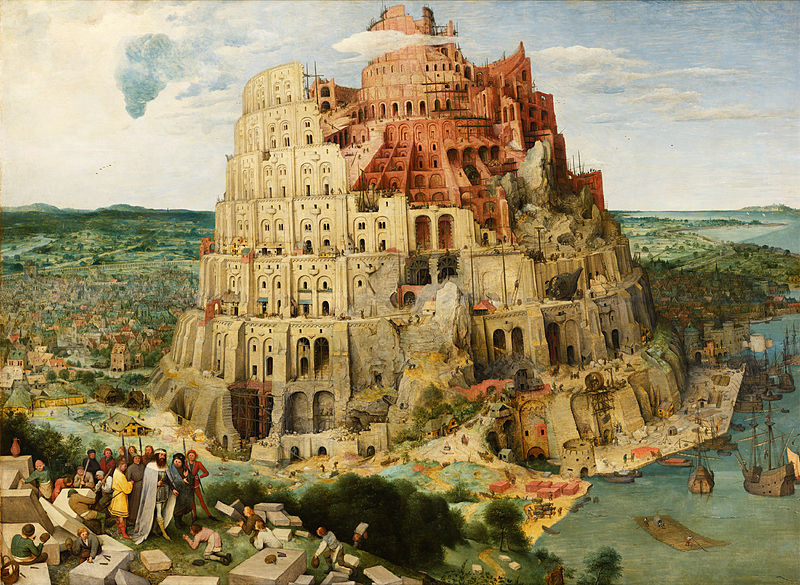
As men journeyed east they found a plain called Shinar
With fertile soil along the rivers Euphrates and Tigris.
Led by Nimrod, that empire builder,
They found common cause,
Saying to one another,
“Come, let us make bricks
And burn them thoroughly.”
With masonic technology
To churn mud into adobe stone,
Sealed, sun-baked and fired
In coal-burning clay kilns,
Binding the mortared bricks
With sticky, black, bitumen tar,
Men could manufacture anything to weather time
And raise their name to the gates of heaven itself.
They said, “Come, let us build for ourselves a city,
And a tower whose top will reach into heaven,
And let us make for ourselves a name,
Otherwise we will be scattered abroad
Over the face of the whole earth.”
Defying God’s grand design to multiply mankind
And fill the earth, to be fruitful, cultivate, and increase;
Denying dependence on divine grace and a perfect will,
Depending on man’s sinful desire to challenge God’s plan,
And avenge forefathers who died in the diluvian holocaust,
Men erected a towering monument to arrogance and hubris.
Raising new heights to avoid the rising waters of future floods,
They began building a pyramid mount with a temple at the top
Dedicated to the moon to honor the hero who defied God’s rule,
Calling the massive, terraced edifice of receding tiers a ziggurat.
Aligned with the rising moon and the seasonal paths of planets,
They marked the passage of time with the gyre of constellations
Circling the zenith and pole star, and augured the fate of kings
From the alignment of celestial orbs and birds in formations.
When they built a house as a foundation for heaven on earth,
The builders stubbornly refused to acknowledge the obvious,
That a tower built by men to reach heaven from earth must fall,
For only a bridge built by God from heaven to earth will never fail;
Yet towers are still built as temples to trade and timeworn treasure,
Where men worship power and greed and the lust to be like God.
Hearing the commotion of labor and the chatter of workers,
Yahweh came down to see the city and the tower
Which the sons of men were building.
The LORD said,
“Behold, they are one people,
And they all have the same language.
And this is what they began to do,
And now nothing which they purpose to do
Will be impossible for them.
Come, let Us go down and there confuse their language,
So that they will not understand one another’s speech.”
In this way Eridu, the first constructed city,
Became Babel,
Because there the LORD
Confused the language of the world,
And from there the LORD scattered them abroad
Over the surface of the whole earth.
In an ironical act, Yahweh fulfilled the tyrant’s fears,
Scattering mankind over the face of the whole earth,
And sparing the creation untold machinations of evil.
Woe the day when men would gather to build towers
To centralize powers through global information nets,
Sealing earth with asphalt and soiling seas with trash,
Burning forests for fields and fueling coal for furnaces,
Sending smoke clouds from chimneys to pollute the sky;
Woe the day when men would gather to rebuild a Tower.
With no common communication, construction ceased,
With no central government, the city remained in ruins,
With no shared vision, nations splintered into factions.
One man called for a hammer and received a nail,
Another climbed a ladder with no wall to avail;
Walls collapsed without supporting pillars,
And bricks slipped without binding bitumen.
In the end no one could decipher the Tower of Babel’s design.
At Babel, spoken languages cascaded off a rift valley into mists
Of roaring waters, the voices of many peoples calling in confusion.
Like the rapids of a rushing river, proto-languages swirled apart,
Branching out into tributaries and channels, merging into families,
Leaving eddies of isolates, and forking into creoles, dialects, and slang.
The semiotics of semantics issued into a plethora of linguistic variations,
Affecting fight or flight, shaping retreats and engagements, molding men
Into creatures of habit and invention, custom, tradition and innovation,
Subject to syntactics and pragmatics and shaping cultural phenomena.
Generations created colloquial codes with nouns, verbs, and adjectives
To brand social groupings, bond loyalty, and inform a common identity.
“Yo, ain’t that the clever truth, dude!” “Write on, y’all, that’s righteous!”
Vernacular vocabularies coexisted with liturgical and literary lexicons,
While elocutions rode the distinction between speech and diction,
Commissioning greetings as sentries to challenge alien intruders,
And establishing shibboleths for cultural touchstones and jargon.
Connotations embroidered denotations with colorful decorations,
Concatenations strung strings of syllables into words with sense,
And cognates spun silken threads for travelers at a caravanserai
Where traders borrowed loan words and bartered them for more.
Linguistic rules shaped arbitrary sounds into specific meanings,
With specific tongues for each nation, tribe, people, and clan,
With exceptions for every rule to accommodate convenience,
And unique patterns of speech for every individual speaker.
Phonology joined morphological typology and semantics
To represent regions of culture, class, nuance, and finesse.
Polysynthetic languages built platforms on synthetic languages,
Assembled from analytic languages using rules of incorporation:
Compounding, suppletion, reduplication, alternation, affixation.
Languages accreted and discarded, shifting sounds and sense,
Shifting orders of subject and predicate even when they agreed.
Spooled together by coordinating and subordinating transitions,
Sentences rambled on according to the logic of grammar
With indicatives always yielding to inflected imperatives,
And adverbs splitting infinitives in jussive mood structures.
Children still easily acquired mother tongues from templates,
But later learned grammar and spelling by rote and correction.
Sophistication discriminated between the uncouth and refined,
Soft languages smoothed indiscretions with secretive sibilants,
Eschewing obfuscating and obscenely obstreperous obstruents
And opting for voiced sonorants, except for voiceless resonants.
Hard, masculine languages dispensed with feminine, soft vowels;
Men chose the language of decision while women were relegated
To pillow talk, whispers and asides to consult, inform, and advise.
Gutturals and glottal stops choked the throat with liquid consonants,
With strident fricatives and uvular trills clustering voiced velar nasals;
While prosodic vowels ranged with pitch, timbre, stress, and rhythm,
With aspirated diphthongs, palatal glides and voiceless approximants.
“Talk normal, man!” This metalanguage’s a beast!”
Agglutinate languages strung together multiple syllables,
Loading a word with voice, mood, tense, aspect, case, number,
Gender, gossip, interrogative, negation, preposition, particles,
Person and possessive pronouns strung like pearls on a string.
Fusionals formed efficient morphemes melting affix to stem,
Whether as prefix, suffix, or infix, glued or fused into forms;
While inflectionals conjugated verbs and declined nouns
By articulating phonemes with allophones and allotones.
Tonal languages sounded the clatter of a tin pot dropped,
Dropped by a drunkard down a long flight of stone stairs,
Intoning contour tones in ejective affricates and plosives.
“You’re killing me, bro! Is this for real? Tell me it ain’t so!”
Weighted down with the gravity of foreign etymologies,
Words acquired baggage and accents in their travels.
Sharpened with precision and dulled with imprecision,
And fixed with cliches like stakes preventing progress,
Words wriggled like slippery eels, sliding into elision.
Ambiguities sent foolish men on wild goose chases,
Searching for buried treasures at the rainbow’s end;
Conjuring mystical systems of esoteric convolutions,
Uttering incantations, spells, and secret, magic words,
Mages wove worlds to seek truth and immortal power;
Worlds of words that burst like soap bubbles in the sun.
Mistrust grew like a mold with every misunderstanding;
With each mispronunciation, suspicion undermined trust.
Seeds blown by the wind, carried by wings, kernels in husks,
Words gathered in valleys, clustered on plains, crossed passes,
Jostled crowds and polished rough edges in polite conversation.
Words laid out treaties promoting peace and the exploits of kings,
Established protocols and laced the courtier’s banter with erudition.
The parlance of lost peoples disappeared like pruned or felled trees,
As stronger idioms surged like influential waves onto weaker shores;
Trade languages bartered in market squares and crowded bazaars,
While empires organized official languages and proliferated scribes
To publish signs, edicts, and official seals in multilingual translations.
While oral traditions continued, written literature conserved speech,
Enabling more faithful transcription, transmission, and reproduction.
Writing systems evolved from pictograms, graphemes, ideograms,
Logographic oracle scripts on tortoise shells and bones,
And mnemonic glyphs etched into cuneiform wedges,
And signed with colophons
On clay tablets and stone chiseled hieroglyphs.
Writing ascended into syllabic and phonetic alphabets
To record ancestries, inventories, histories, and stories
On ostraca pottery sherds, stone slabs, and clay tablets,
Or in hieratic script with inked soot on pressed papyrus,
Parading ordered lines to unravel the secrets of the past.
Poetic sages invested inspiration with interpretations,
Burying divine flashes of truth beneath verbal heaps,
With devotionals, texts, and tomes of abstruse myths
In Sumerian, Akkadian, Ugaritic, Aramaic, and Sanskrit,
And later Egyptian, Arabic, Avestan, Persian, and Greek.
So came to be the Gilgamesh Epic, the Homeric Epics,
The Gathas, the Vedas, and the Upanishads,
The Bhagavad Gita and the Mahabharata,
And the Egyptian Book of the Dead,
Among the literary relics of dead cultures.
Libraries became alvearies of knowledge,
Where men could treasure their erudition.
But the Hebrew Bible was authored by God
In the original language spoken by men,
Through the inspiration of the Holy Spirit
Moving men to speak and write for God
Like a lamp shining in a deep, dark recess
Until the day dawns and the morning star
Arises in your God-breathed hearts.
From the Tower of Babel
Men scattered like a kicked termite mound or ant’s nest;
Buzzing like angry bees swarming in confusing babble,
They scurried in all directions over the face of the earth.
Although men took the Flood story wherever they went,
Changing our names and twisting the tale to their fancy,
In latter days they began to doubt my account’s veracity
And question the details with disbelief and peradventure,
Pointing to the impossibility of fitting all surviving species
Into a wooden vessel three hundred by fifty by thirty cubits,
Much less be carrying enough food to feed them for a year.
They pointed out that the ark’s proportions equaled in scale
The proportions of a man lying down, and must be figurative.
They asked who had built the ark, since it was impossible
For four men to have hoisted beams without assistance,
Implying that the profane had a role in the sacred play
And deserved a better reward than drowning in the deluge.
They asked how the animals didn’t breed and overpopulate,
And whether carnivores could be kept from eating herbivores.
They not only questioned the ark’s size, shape, and construction
But also the chronology of events and the Flood’s universal reach.
Ironically, to a man they all agreed the reprobate raven had failed
To return to the ark in order to feed on floating carrion carcasses.
A few posited the existence of survivors who escaped on rafts,
Or clung to tree trunks swept along in the rising flood tide,
Or crossed land bridges to new worlds at the earth’s edge.
Some went so far as to divorce religion from hard sciences,
(While others married the soft sciences to religious thought),
Separating reason from faith (and turning reason into faith),
Isolating belief from proof of evidence (“seeing is believing”),
Accepting with condescension the story as instructive myth,
But openly challenging the narrative’s physics and geology.
My only answer to the doubters was, “Were you there?”
It’s easy to disbelieve what you didn’t see,
And facile to mock what you don’t know,
And shallow to poke holes at miracles
When you have no other explanation.
Suffering from anosognosia, solipsism and sophistry,
Men questioned the creation and elevated Eve’s defiance
As a Promethean feat that brought divine fire to mankind.
Many doubted that the creation was made in seven days,
Conjuring alternative cosmologies of fluid consciousness
With no beginning nor end.
They mythologized a creator god battling monster chaos,
The dismembered carcass providing creation’s materials;
Or of a turtle and four elephants supporting the universe,
Or of Ouroboros, a world coiling, self-devouring serpent,
Or of a Big Bang that exploded all being out of nothing,
Or of complex life evolving from single-celled amoebas
Without the divine intervention of an omnipotent hand.
Some surmised that before Adam other men were created
To explain the physical variety and range of the human race.
They suggested that Adam consorted with a spirit night hag,
And that Eve had relations with the serpent and bore Cain.
Others railed against God’s disproportionate injustice, His
Unjust violence at not fitting the punishment to the crime,
Pointing to the terrible tragedy and casualties of the Flood
As proof of divine intolerance and callous disregard for life.
They questioned the severity of bad Cain’s badge of shame,
And the injustice of the curse on Ham’s fourth son Canaan.
Some speculated that Ham had fornicated with his mother,
Castrated his father, or sodomized him when he lay drunk,
Triumphing over his father in an act of defiant, filial rebellion.
Some perverted Nimrod into the hero of a homoerotic epic
That portrayed the Flood God as a vanquished monster,
And the quest for eternal life as futile and dangerous.
Some even questioned God’s existence and presence,
As if this world was all there is and then nothing more;
Calculating that chance had set the universe in motion,
Replacing wisdom as designer and driver of life’s odds.
Some set up man on the throne of God, usurping power
And knowledge, measuring all things in man’s one rule;
As if men knew where we came from and where we go;
As if the origin and destiny of man were to become God.
Others conjured up mythologies of fickle, spiteful deities
To explain life’s uncertainties, fate’s vagaries, sad tragedies,
Destiny’s disasters, unpleasant surprises, and sheer bad luck.
They began to worship fire, the sun, moon, stars, air, and animals
As gods, canine and feline, falcons and elephants, cows and kites,
And kings as divine, crowned with heaven and enthroned on earth.
They believed in a primeval sea goddess who engendered the gods;
Revered a queen of heaven who nursed an earth king at her breasts.
They began to offer oblations of fruits, drinks, and flowers at shrines
In their homes devoted to the hearth goddess and sly house sprites
To propitiate mischief, decode the horoscope, haruspicate, and scry.
They turned priestesses into temple prostitutes offering sexual favors,
Recruited nubile boys for powerful men whose lusts corrupted desires,
And sculpted terra-cotta figurines with giant mammaries and phalluses
As idols invested with magic powers to grant fertility, fecundity, and fun.
Attempting to appease fickle elemental forces with ritual votive offerings,
They consulted mediums for divinations, auguries, omens, and oracles,
Calling on the spirits of the dead, deceased ancestors, and phantoms.
Secret cults arose to follow the trinity of dragon, serpent, and beast,
Performing secret rites to conjure up abominable demonic shapes;
Inhaling hemp smoke and the milk of poppy pods, drinking soma
And the wine of fermented fruits, intoxicated revelers in frenzied
Dance tore flesh apart in bacchanals, fornicated in lustful orgies,
And offered their bodies and souls for possession by malignities.
Even my own descendants began to adopt their neighbor’s idols
And lent their godly legends to empower those heathen myths.
How quickly man forgets that a good God made him for good,
And defaults to live to man’s measure, and not to God’s truth,
In which it is written;
“For they exchanged the truth of God for a lie,
And worshipped and served the creature
Rather than the Creator,
Who is forever blessed,
Amen.”
At the top of ruined ramparts,
A peregrine falcon fought a fox;
Quick as a flash, the fox pounced,
Dragging down the bloodied bird;
Wings drooping, eyes clouded,
The falcon whispered a boast,
“We rule the sky!”
REFERENCES:
Genesis 11
Romans 1:25
Isaiah 55:10-11 NIV [10] As the rain and the snow come down from heaven, and do not return to it without watering the earth and making it bud and flourish, so that it yields seed for the sower and bread for the eater, [11] so is my word that goes out from my mouth: It will not return to me empty, but will accomplish what I desire and achieve the purpose for which I sent it.
T.S. Eliot, Dry Salvages, Four Quartets.
http://www.biblearchaeology.org/post/2006/10/30/Who-Was-Nimrod.aspx
 The Covenant of love
_-_Google_Art_Project_-_edited.jpg)