After the Flood, my brothers and I founded large families
That grew into clans, tribes, great nations, and empires
Scattering across continents and spreading over earth
In fulfillment of God’s blessings and His grand design.
Clan chieftains and family heads, bearing patronyms
Perpetuated in toponyms and enshrined in ethnonyms,
Bestowed their ancestral names to peoples and places,
Each with their history, territory, chronology, and culture,
Each developing their distinct speech and language patterns,
Each marked, rooted, and determined by God to live according
To their appointed times and the boundaries of their habitation,
So that they would seek Him and perhaps grope for Him,
And find Him, though He is not far from any one of us,
For in Him we live and move and have our being.
Some nations were unknown by the known world,
Some names were lost to time in unknown places,
Others became known to history with new names,
But all are known in all places and names by God,
Who made from one man all nations of mankind,
Being then all children and offspring of God.
This then is the Table of Nations
Descended from Noah’s three sons and sixteen grandsons
Who founded seventy nations dispersed across the earth.
These emerged from the crossroads of three continents
Revolving around history’s axis: Africa, Asia, and Europe,
Swinging in turn and time around the Middle East
Like rising and falling puppets in a shadow play.
Fourteen great nations came from Japheth,
Thirty from Ham and twenty-six from me, Shem.
Japheth had seven sons settling lands from east to west:
Gomer, Magog, Javan, Madai, Tubal, Meshech, and Tiras.
These seven sons of Noah’s son raised their tribal totems
Across the Eurasian continent from the Caspian and Urals
To the Garden of the Hesperides edging the World Ocean.
From them came the peoples surrounding the Black Sea:
Bithynians, Thracians, Dacians, Cimmerians, Armenians,
Cappadocians, Ionians, Iberians, Colchians, and Mushki,
All dwelling in settlements around the Inhospitable Sea,
All jostling each other like dust motes in a sunbeam.
They built forts ranged on Crimea’s rugged cliffs,
Buried their dead in the sands of the Danube delta,
Farmed and fished along the Dniester and Dnieper,
Raised stilt houses on pilings in the Sinop Peninsula,
Swung open the hinges of the high and low Caucasus,
Sang a mountain of tongues flowing from snowy peaks,
Spilled into valleys across two ranges between two seas,
And rarely ventured out onto the storm-driven waters. So,
Japhet sired the many families of Indo-European peoples
Who migrated beyond to the farthest reaches of the world.
Recorded by men’s histories with various names,
Gomer’s sons: Ashkenaz, Riphat, and Togarmah,
Became the Teutons, Phrygians, and Tocharians,
Copper wielding warriors wandering and thirsting for wine,
Restless nomads roaming the northern steppes and forests,
Red beards mummified in the desert oases of the vast Tarim,
And gold-fevered fools lost in deep gorges and high crags.
Ashkenaz had ten sons in the west:
Celts, Gaels, Picts,
Bretons, Gauls, Goths,
Saxons, Jutes, Slavs, and Balts.
Tall and pale with hair flowing flax and wheat,
Crafting corded ware pots and bell beakers,
Their art spread with burials in pit graves
From the east to the far western isles.
Togarmah had ten sons in the east:
Uyghur, Taurus, Turk,
Bulgar, Avar, Khazar, Hun,
Sabir, Bashkir, and Kyrgyz.
These scattered across Europe and Asia
In great cavalcades of nomadic cavalries
Raising dust storms across the steppes
Until buried in barrow mounds on tells.
Magog also went north on horses
And built an empire of gold.
Warring astride a saddle, steady in stirrups and reins,
Suited in scale armor, gilded cuirass, and golden crown,
Shooting backwards at full gallop with a composite bow,
Crafting exquisite brooches depicting full-antlered stags,
Casting gold goblets, combs, buckles, torcs, and plaques,
Sheltering in felt yurts festooned with tapestries and rugs,
Feasting on horse flesh and drunk on fermented mare’s milk,
Magog buried kings with favored steeds fit for equestrian glory,
Crowned brave maidens as queens to lead strong men in battle,
And sired the fierce tribes of Scythians, Sarmatians, and Sakas.
Madai followed Magog’s migration eastward across the steppes
Through the Dzungarian Gate and the cave of icy, winter winds,
Across the defiles of the Altay where griffins guard hills of gold,
Reaching as far as the confluence of the great and little Yenisey,
Until stopped by Turks and the barren dunes of the Gobi wastes.
Madai’s tribes then descended into Central Asia, streaming down
From the vast plains of Turan across to the high plateaus of Iran,
Spawning the feared nations of Medes, Magi, and Massagetae.
Following horse herds from far lake shores to green river valleys,
They sent hordes south over the Celestial Mountains to the lands
Of Aria, Ariana, and Arachosia. Pressing east beyond the Indus,
And west through the yardang pillars of the Iranian salt deserts,
They launched waves of invasions, streams of migrations, clans
Crossing through the Moyunkum, Kyzylkum and Karakum sands.
Settling the fertile oases of Kwarezm around the inland Aral Sea,
Following the Oxus and Jaxartes rivers to their mountain source,
Climbing the steep valleys in Nuristan and up Mount Damavand,
They then colonized Khorasan to birth empires of proud people.
Elevating pure blood over old, and asserting dominant tongues
Of the Aryan race from Ecbatana to Soghdiana and Marghana,
Madai aspired to world conquest, world domination, and glory.
Javan fathered the maritime, island, and coastland sea peoples
Through his sons: Elishah, Tarshish, the Kittim, and the Dodanim.
The Dodanim were the first to settle archaic Greece, then the Kittim
Came in successive waves, through Cyprus and the Aegean islands,
Convulsing their known world with invasions, ideas, idols, and icons;
Of their origins, confusion is mixed with mists, myths, and legends.
Joining wandering tribes of Thracians, the Dodanim engendered
The Pelasgians and Illyrians who inhabited the Balkan coastland
And swore to defend their lands against encroachment by Kittim.
Rallying at the sacred oak grove in remote Dodona of rainy Epirus,
At the foot of the Pindus Mountains that form the spine of Greece,
Pelasgians and Illyrians sallied forth to fight off waves of invasions,
To no avail.
Defeated and displaced, they migrated across the Alps to become
Venetes, Rhaetians, Etruscans, Ligurians, Aquitanians, Lusitanians,
And the many tribes of Iberians settling beyond the misty Pyrenees
To the sun-bathed shores of Hispania and the fabled Balearic Isles.
Fighting rearguard battles along the Dalmatian and Liburnian coasts,
Some sailed across the Adriatic Sea to southern Italy; some traversed
The Tyrrhenian Sea to people the Tuscan and Aeolian archipelagoes,
Settling Sicily, Sardinia, Corsica, and the isle of Malta; some marched
North, past the Istrian peninsula to Pannonia on the Danube River;
While others retreated over the Dinaric Alps to the hills of Dardania,
Where roses grow wild in thickets and brambles exude fragrance-
Perfuming breezes; while grape vines color hillsides carmine blood.
A Pelasgian remnant found refuge on the Aegean island of Lemnos,
An Illyrian tribe hid in the crags of the remote Accursed Mountains,
Others, settling on the island of Rhodes, were known as Rodanim,
While the rest, assimilating like melting ice in warm Grecian waters,
Taught the invaders to build cyclopean walls and to scribble scripts
Of inventory lists with linear lines on clay tablets stored in clay jars.
The children of the Kittim and Dodanim built restless civilizations,
Engendering legends of Sea Peoples who pillaged and destroyed,
And gained renown as sailors, sculptors, philosophers, and poets.
According to their mythology, the Kittim descended from a Hellen,
Father of the Hellenes and the Greek tribes who settled in Hellas:
The Achaeans, Ionians, Dorians, Aeolians, and the Macedonians.
Javan‘s name was Hellenized to Iawon, ancestor of the Ionians;
Japheth’s name became Iapetus, a Titan, father of Prometheus,
Who stole the fire of the gods, and Atlas, who shouldered earth;
One was captive in the Caucasus, the other at the western rock.
Hellen was the son of Deucalion, a sailor who made sweet wine
And whose father was Prometheus. Hellen’s mother was Pyrrha,
Pandora’s daughter, the all-gifted first woman whose curiosity
Brought evil and misery to men.
The Greeks believed the sky god Zeus, angry at the Pelasgians
For sacrificing innocent children, sent a Deluge to drown earth.
Deucalion and Pyrrha survived the Flood by floating in an ark;
They repopulated earth by throwing stones over their shoulders,
And by this artifice the Greeks claimed the primogeniture of men,
Justifying the primacy of the Kittim over the Dodanim in all Greece.
The Kittim cousins colonized the new lands claimed for the old gods,
Settling Thessaly, Aeolia, and Ionia to the four-fingered Peloponnese,
To Moesia and Macedonia, Euboea and Boeotia, Attica and Arcadia;
From Corfu, Ithaca, Cythera, and the seven islands of the Ionian Sea,
To the Aegean archipelagoes: Sporades, Cyclades, and Dodecanese,
A whirlpool of islands spiraling round turquoise and sapphire waters.
Fetching furs from the northern forests beyond the Propontis straits,
Towing barges by bullocks up the broad Borysthenes, past pastures
Where Scythians and Slavs scythed grasses for fodder and thatch,
Triremes sailed laden with amber and grain from Chersones Taurica,
Leeward down the Black Sea through the Bosphorus and Hellespont,
Founding Greek trading colonies across the long Mediterranean Sea
Like frogs around a pond croaking out songs of the wine dark seas.
The sons of Elishah won renown as bull-leaping, acrobatic Cretans
Who founded the fabled Minoan and epic Mycenaean civilizations.
The Mycenaeans built high hilltop fortresses with cyclopean walls
To protect the Argolid city-states of Mycenae, Tiryns, and Argos,
And the acropolis of Orchomenos and Nestor‘s palace in Pylos,
And the great tholos tombs filled with griffin seals and pottery,
With vases and vessels to hold unguents, oils, and ointments,
With glass vials and lacrymatories to catch mourners’ tears,
With beads of carnelian, amethyst, amber, ivory, and gold,
With bronze weapons of warriors wearing gold Minoan rings,
And the golden face masks of kings gazing sightless at death.
They dedicated the first temple at Delphi to the earth goddess,
Before the Greek sun god slaughtered the pagan dragon Python,
And the chthonic Sybilline oracle ceded to the Pythian priestess.
Up the steep ravine, pilgrims climbed to the high, misty crags,
Where the rocks communed with clouds in mystical rapport.
Bathing with ritual ablutions and drinking from holy waters
Bubbling up from subterranean wells of the Castalian spring,
Vapors cloaking the omphalos stone at the navel of the world,
The curious and faithful pressed the veil to peer into their future,
Treasuring every cryptic pronouncement of the Apollonian oracle,
As if confusion could yield to clarity.
The Minoans built labyrinthine palaces at Knossos and Phaestus
On the coastal hills of Crete, fertile isle of vines, fruits, and grains.
Sailing from the port city of Amnisos, ships took men and goods
Around the Mediterranean, from Egypt to the Levant and Greece;
And launched a navy to tame pirate seas and rule stormy waters.
With a sewage system flowing running water from flushing toilets,
With lustral basins and blue dolphins swimming above doorways,
With ample storage chambers replete with still rows of pithoi jars,
Their thalassocratic empire boasted paved stone roads leading
From the port to the palace, through ornate gates to the square,
Along wide boulevards and a long, oblong, ceremonial courtyard,
To the temple of the snake goddess holding serpents in her fists.
Famed for sacrificing young tributes to the Minotaur in his maze,
For dancing with enraged bulls, somersaulting over furious horns;
For their great wealth, refined tastes, and clear, colorful frescoes
Depicting coiffed, bejeweled, bare-breasted, and wasp-waisted
Women, the Minoans loved dances, drama, hunting, and sports.
Their seductive maidens, vain with beauty, wore gold and silver
Rings and pendants of embracing bees; charms and plaques
And chains of stylized flowers; bronze arm bands and snake
Shaped bracelets; signet rings of silver-gold vermeil; agate,
Amethyst, carnelian, and steatite beads strung in necklaces;
Cameos and intaglios carved in sardonyx depicting the gods,
And hairpins, stickpins, and diadem fillets with filigree spirals
Adorning their scented bodies designed to entice effete men.
Felled by famine, an erupting volcano, and monstrous waves,
The Minoans met their cataclysmic end when Thera erupted;
In weakness, they surrendered to the rule of Mycenaeans,
But the Mycenaeans collapsed into the Greek Dark Ages,
Leaving behind castle walls and a lion gate opening to all;
A final testament to hubris.
The children of Tarshish appeared on the Levantine coast
As mysterious as their origins shrouded in pre-historic mist.
Settling the littoral cities of Byblos, Tyre, Sarepta, and Sidon,
Tarshish built up the maritime nation of fearless Phoenicians.
From the red Erythraean Sea to the Euxine Sea’s black deep,
Sea-faring Tarshish ranged far and wide in pursuit of trade.
As paragons of prosperity, the Phoenician fleet flew flags,
Crimson and purple briskly crackling from the topmast,
The square sail taut with rigging singing with the swell.
They sailed fair winds and followed stars to far ports,
Sending out intrepid sailors and shrewd merchants
To sell prized purple dyes made from murex shells
To color royal robes and banners of warring kings.
Bartering bolts of cotton cloth dyed Tyrian purple,
The color of crimson blood married to an azure sky,
With resilient timbers and pillars of Lebanese cedar
For the construction of temples, palaces, and fleets,
They leveraged comparative advantages and thrived,
Their business acumen honed by knowing men’s needs.
At the crossroads of caravans with harbors full of ships,
The Phoenicians grew a global trade rivaling the Greeks,
Managing a maritime empire across the Mediterranean,
And vying for the fickle favors of despots and autocrats.
Granaries overflowing with wheat, barley, millet, and rye,
The golden grain packed into barrels and sealed in sacks,
Were counted and loaded into the holds of rounded hulls,
Then shipped to feed the world and fan imperial influence.
Blocks of salted tallow fat, stacks of tanned leather hides,
Packs of pungent resins from terebinth and mastic trees,
Baskets of carob pods, and sheaves of flax and papyrus,
Were carried overland to warehouses in Phoenician ports,
Then bought and sold at auctions to bloat traders’ purses.
Exporting glass, wine, gems, olive oil, and honey to Egypt,
In exchange for ivory, ebony, alabaster, aloes, and apes,
The harvest of the Nile was sold for the revenue of Tyre,
And the treasures of Sumer sent to the stores of Sidon.
They traded wool from Arabia, linen and cotton cloth
From Syria, silk from Serica, hemp fiber from Persia,
Perfumes from India, incense and spices from Nubia.
They brought a dancing dwarf from Yam, and singers
With musicians from Cyrenaica to the Pharaoh’s court;
They auctioned Nubian and Khoisan slaves from Africa,
And kidnapped pretty maidens for the Persian harems.
Inventing an agile, adaptable alphabet to tally accounts,
They traded in iron, coal, lead, tin, copper, gold, and silver;
Copper and tin to forge bronze bowls and weapons for war;
Iron for steel; gold and silver for status, treasure, and greed;
Lead for plumbing, piping, pewter plates, and pottery glazes;
And coal for kindling and burning in metal smelting furnaces.
Great cultural borrowers, the “purple people” heirs of Tarsus
Dressed in oriental fineries and ornate Scythian accessories;
Worshipping Canaanite gods in opulent temples; colonnades
Shading pilgrims from heat; speaking a Semitic language
Akin to Hebrew, Aramaic, and Arabic; indulging in luxury;
Raising stone obelisks; writing records on papyrus scrolls;
And choosing to be buried in gilded Egyptian sarcophagi
With gold scarab beetles to roll the setting sun’s descent;
The Phoenicians plied their commercial routes with profit,
Supplying bazaars to become the marketplace of nations.
Settling colonies in Etruria, Malta, Sicily, Sardinia, Corsica,
Utica, Carthage, Cadiz, Tingis, Lixus, Tartessos, Mogador;
And further, beyond the Pillars of Hercules,
The Punic sea-horse fleets ventured north,
Seeking tin in Penestin, Galicia, and the Scilly Isles,
Their galleys blown by gales to distant windy shores
Of Celts, Caledonians, Hibernians, and Hyperboreans,
Themselves close cousins to the western Germanic tribes.
Legends tell of Phoenician ships disappearing into the west
And sailing south around the tip of Africa to the far Celebes,
Never to return except by rumor and remnants of shipwrecks;
Stories discounted by serious men and repeated by cowards.
Leaving behind a scattering of clans to wander Anatolian hills,
And the prophecy of a prince of Rosh at the head of a horde,
Tubal and Meshech explored the high steppes beyond Magog.
Beyond the pale of the eastern Urals they raised a sacred site
Named Arkaim, and a string of round, wooden, fortified towns
To trade furs and stolen girls for bronze weapons and wares.
Tiras disappeared into the far northern swamps and forests
To herd reindeer in the tundra and trap beavers in the taiga,
Awaiting a final gathering of nations at the end of the age.
From these, Japheth’s sons separated by coastlands,
Every one according to language, clan, and family,
Each into their nations.
Ham’s four sons pushed south
From the cradle of civilizations
Deep into the African continent.
Cush, Mizraim, Put, and Canaan
Begat the Sumerians, Ethiopians,
Egyptians, Libyans, and Canaanites.
Cush founded Kish, the first Sumerian city,
Built between the Tigris and Euphrates Rivers
To stand sentinel and collect tribute from trade.
The Sumerians settled the flood plains of Shinar,
The first civilization speaking the first language
In the first mud metropolis built after the Flood
Had washed away ruined cities of the Cainites.
Cush was also the father of Nimrod, the Rebel,
Who became a mighty warrior on the earth,
A mighty hunter at war with the Lord,
Slaying lions in the grasslands
And tigers in the reeds.
Nimrod was a master of men,
A builder of cities and empires,
The first tyrant given power to rule
Over rootless peoples after the Flood.
The first centers of Nimrod’s kingdom
Were Babylon, Uruk, Akkad, and Kalneh, in Shinar.
These Sumerian city-states grew in power and trade;
Founded when fishermen and farmers joined herders
To organize an economy built on the backs of slaves.
Managed by magistrates and a priestly magisterium,
By lords of the land attending a priest king in council,
Receiving tribute from vassals and quarreling tribes,
Building high temples to house gilded idols of gods,
Taming time by riding a calendar of sun and moon,
Erecting fortified walls to repel nomadic marauders,
Supported by ranks of tax collectors and landlords,
Fed by shepherds and harvests of collective farms,
Plagued by old beggars, pickpockets, and urchins,
Entertained by bards, dancers, poets, and harlots,
Playing music on the pipes, drums, horn, and lyre,
Warring with chariots, cavalry, and infantry arms,
Sporting with horses, boxers, wrestlers, and dice,
Peopled by cohorts of builders and bureaucrats,
Guilds of artisans, tradesmen, and merchants
Selling produce in open markets and bazaars,
Bartering with uniform weights and measures,
Cheating with dishonest exchanges and scales,
While ubiquitous scribes recorded transactions,
While spies in disguise ferreted out information,
While thieves and murderers hid in the shadows,
While doctors treated wounded, sick, and dying,
While legions of professional priests and soldiers,
Trained in the magic sciences and the arts of war,
Paraded the streets in loud pomp and pageantry,
While the poor picked through the ever-growing,
Burning mounds of refuse, miasmal with smoke;
So the city states of Sumer conceived civilization:
Cores controlling peripheries by trade and sword.
In Sumer, dedicated followers devoted to divinities
Yielded to dynastic kings wielding absolute power
To war against rival kings for the favor of pet gods.
One large stone stele celebrated such a massacre,
Recording the battle between Umma and Lagash:
Triumphantly helmeted soldiers shielding spears,
Marching in serried ranks trampled the defeated;
Vultures gripped severed heads in curved beaks;
A lion-headed eagle, monster-demon on a mace,
Carried a cage of mutilated bodies over the fray;
A horn-headed mountain goddess presided over
A sacrificial bull; a dancing, delirious naked priest
Leaping in blood lust on death registers of stone
Commemorated the land dispute between cities;
So the Sumerian states snapped at each other
Like snarling, rabid dogs.
Listed in Sumerian king lists was a priest king
Of epic fame, one Gilgamesh, usurper of Uruk,
Son of a mage, possessed of boundless vigor,
A tyrant raping brides on their wedding day,
Who entered the sea, ascended a mountain,
And fortified city walls with northern cedars.
Scorning the wise counsel of elder advisers,
And rallying the council of young firebrands,
Gilgamesh tried three times to conquer Kish.
Successful on the third siege, he was lauded
And crowned king of Kish, Uruk, Ur, and Nippur,
The first conqueror of the fractious states of Sumer,
And the hero king of the first eponymous epic poem.
Written in cuneiform on clay tablets, the Gilgamesh
Epic told of his quest to overcome the fear of death
And the meaninglessness of life by appeal to a god.
Surpassing all other kings, seeing deep the unknown,
Humbled and subdued by the death of a wild friend,
In prolonged grief until a maggot fell from his lover’s nose,
Gilgamesh began his wanderings in search of solace.
Crossing vast oceans and mountains to world’s end,
He met an ancient one and asked him for immortality.
Unable to stay awake six days and nights of creation,
Unable to guard a garden from an evil, deadly snake,
Failing the tests to gain immortality, Gilgamesh died;
His epic fame living on, he was deified a popular god.
From Shinar, Nimrod went upriver to colonize Assyria,
Where he built Nineveh, Rehoboth Ir, Calah and Resen,
Located between Nineveh and Calah–
The great city of our time.
Wherever Nimrod went he left
Piles of plain, rough, beveled rim bowls,
Mass produced in molds to hold rations
Of barley and oil to fuel the labor of workers,
And feed the trains of slaves who built his cities.
Other sons born to Cush, forefather of the Cushites,
Were Seba, Havilah, Sabtah, Raamah and Sabteka.
Hunters, herders, nomads, and explorers, the sons
Of Cush followed coastlines, riverbanks, and wadis
West to the desert and south past the African Horn.
The sons of Seba married the daughters of Sabtah,
And fathered the Sabeans who settled in Arabia,
Mixing with the sons and daughters of Sabteka.
Havilah followed the Pishon River past its source,
Furthest south where the World Ocean divides
In swells of crashing waves, where seabirds
Wheel with piercing cries and nest in crags
On a rock-wracked cape of storm and fog;
Traversing a rift valley of forgotten origins,
Past lakes like seas and domed mountains,
Snow mountains that glowed like the moon,
Past a curtain of water roaring over a gorge,
Dropping the world’s rivers into a deep abyss,
Raising columns of mist steaming to the clouds;
So Havilah discovered wealth beyond measure
In a land of gold, rich in gemstones and metals.
Mining onyx stones, polished for pottery bowls,
And for royal jewelry: pendants and necklaces
Adorning the necks of queens, green emeralds
And clear diamonds set in the crowns of kings,
The riches of Africa poured from rock and bush;
From bdellium resins tearing down myrrh trees
To make frankincense, fragrances, and sweets,
And acacia thorn sap oozing gum arabic drops
For inks and drinks and cosmetic skin vanities.
So Havilah roamed across a vast continent
Rich in treasures and herds of great game.
Conquering crocodiles and the maned lion,
Trading in ivory tusks and rhinoceros horns,
Carrying wares to the emporium of Rhapta,
And filling fleets bound for the ports of Punt;
The sons of Havilah would build great cities
That crumbled into ruins covered by jungle,
Buried under sand, lost in winding canyons,
And overrun by baboons, termites and owls.
The sons of Raamah were Sheba and Dedan;
They followed the Nile past the sixth cataract
To the confluence of the White and Blue Niles.
Driven by curiosity they turned east to the sun,
Lured by the trail of gold and the hope of trade.
Up the River Gihon to its source from Lake Tana,
Past the smoky Blue Nile Falls to the Land of Punt,
They climbed higher into cool valleys and plateaus;
Past the vast flocks of chattering pink flamingoes
Thronging the calderas of Abiata, Shalla and Chitu;
Past the Tigray Escarpment to the Great Rift Valley,
Following herds of wildebeest, zebras, and gazelles.
Along the Awash River in the land of the fierce Afar,
Past limestone chimneys steaming from Lake Abbe,
Mule and camel caravans crossed empty salt flats
Skirting past strange soda lakes flocked with birds,
Bearing cargos of salt blocks to far harbor markets.
Across hot shimmering sands of the Danakil Desert,
Treading wastes where animal skulls and skeletons
Bleached in white hot heat, pack trains plodded on,
Past the suppurating sulphur pools of hell’s gateway,
Where earth’s raw wounds bleed steaming fissures,
Where lava lakes boil fire, vents erupt poison fumes,
And mud geysers grow mineral pillars; where acids
Collect in emerald pans with sapphire bands, where
Burnt cinder cones and clinkers create demon castles;
Where the sun burns away shade in the blistering dirt,
Where flies swarm by day and scorpions rule at night,
Where clouds of choking dust bury the living green,
And death stalks the weak, weary, and infirm.
The thundering sons of Raamah toiled in the heat,
Settling the Cushite highlands to the Horn of Africa,
Exploring the lands of the rising sun, the land of God.
Along both Red Sea shores south of Egypt and Arabia,
Building cities from Yeha to Naqa, Napata to Mazaber,
From Berenice Troglodytika to Berbera beyond Azania,
Erecting tall palaces, temples, and pyramids in Meroe;
Their children ruled the kingdoms of Kerma and Kush,
Their children ruled the kingdoms of Nubia and Sheba,
And their children the kingdoms of Axum and Abyssinia.
Renowned for their archers, their ivory, ebony, and gold,
For their carved coral statuettes and turtle shell combs,
For their fearless divers retrieving precious white pearls,
For their fishing fleets returning at dawn, laden with fish,
For their preservation of the prophetic oracles of Enoch,
For their powerful medicinal percolation as black as ink,
And for a wise queen who journeyed far to find wisdom,
The tall Ethiopians proudly ruled their extensive realms.
Crossing the Gate of Grief, Dedan continued full circle
To Dhofar, sending caravans of incense and saddles
Bound across the desert sands to far northern ports.
From the harbor at Khor Rori, Dedan’s descendants
Launched ships carrying frankincense and filigree,
Peacock plumes and gold from the mines of Ophir,
And fruit from the fertile coast of a bountiful land.
Enriched by trade with India, Egypt, and Assyria,
The port of Moscha Limen in the Land of Incense
Emerged from the sand like a tall, fragrant flower,
Until wilted by the desert sun.
Mizraim became the father of the Ludim, Anamim,
Lehabim, Naphtuhim, Pathrusim, Casluhim
(From whom came the Philistines), and Caphtorim.
Mizraim’s children settled in the lands of the falcon, vulture, and cobra,
From north to south along both palm lined banks of the long, fertile Nile.
Revering the aloof cat, taming lions and leopards, hunting with cheetahs,
The Egyptians built a cult of death, presided over by Anubis, a jackal-god.
Idolizing the Scorpion King, the red kingdom’s white-crowned conqueror,
Power, wealth, and renown obsessed the pharaohs to rule in the afterlife —
But in this life their hegemony lasted millennia and their fame for all history.
From the great temple of Ptah in Memphis, built by the legendary Menes
Who united the Upper and Lower Kingdoms, to honor the creator God
Who thought the world and by his creative word brought it to being,
To the great temples of Amun and Ra in Theban Luxor and Karnak,
To Imhotep’s first pyramid for Djoser and the great pyramids of Giza,
And the funerary mastabas and necropolises of the cult of the dead,
Egypt gleamed with sun rays plastering stone, white walls and gates,
Colossal statues, and cavernous halls erected by powerful pharaohs
To deify themselves.
Surrounded by a phalanx of sycophantic priests organizing worship,
Choreographing ceremonies of folk festivals to entertain the people,
Regulating rituals and practicing magic arts to manipulate elements,
The pharaohs were declared gods on the earth, “Lord of Two Lands.”
Red crown rising on white, they ruled through hereditary dynasties
To maintain balance, order, and justice in concourse with the gods.
They conjured up the Nile’s flood cycles to silt fields with black soil,
And so guarantee the fertility, fecundity, and felicity of the people
By assisting in assimilating with Osiris, consort of Isis, sire of Horus,
Green-faced god of the underworld, Lord of the Dead and Silence,
Through the ritual eating of his body.
In the hope of regeneration, transmigration of the soul, and new life,
The bodies of deceased pharaohs were carefully prepared for death;
Their eviscerated bodies were embalmed and dried in natron salts.
Mummified for the afterlife, their corpses washed with palm wine,
Internal organs removed, desiccated, and stored in canopic jars,
The brain sucked out through the nose and the heart restored,
Their empty body cavity stuffed with sawdust, leaves, and cloth,
Wrapped in linen strips soaked in resin, camphor, and castor oil,
Then placed in a sarcophagus gilded with their painted likeness,
The lords of life became lords of death, preserved for an eternity.
Provisioned by art, gold, jewels, statues, foods, and furnishings,
Protected from plundering tomb raiders by amulets and spells,
The pharaoh’s three souls stayed, wandered, and journeyed
To face judgement in the underworld.
For their deeds, their achievements, their good works, and just rule,
They weighed their hearts on a scale balanced by a feather of truth,
Displaying the monumental ambition of man’s rebellion against God.
Buried in a central tomb circumscribed by a labyrinth of catacombs,
In death attended by a hecatomb of courtiers, minions, and slaves,
The pharaohs elevated the glory of man to the high halls of heaven
Where a god-king could consort with the gods in familial conclave,
Claiming the power and authority of divinity in this life and the next.
Hiding the mysteries of power, the treasures of wealth and wisdom,
The Great Sphinx of Egypt still surveys time’s sands with stone gaze,
And no nose.
Put pushed westward past Marmarica and Cyrenaica to Lake Tritonis,
Fathering the Amazighi free men: the Berbers who birthed the Libyans,
The Kabyles, the Riffians, the Fezzan Garamantes, the fierce Tuareg,
The Guanche of the Canary Islands and the ancient Nasamon tribes,
And further west, the Numidians and Mauri who mounted cavalries
Like wild centaurs skilled in battle, sweeping across the Atlas range
South to the recesses of the Acacus, Ahaggar, and Air Mountains.
Across the Sahara Desert they traded, from Gao to Ghadames,
From Ghat to Fez, from Timbuktu to Marrakesh, from Zouar to
Murzuk, in cycles of climes now wet, now dry, forest and sand
Extending east to west, from the Red Sea to the Rio de Oro,
From the Oasis of Amun Ra to the surf of the Great Ocean,
From the barren Tanezrouft to the arid wastes of El Djouf,
From the lost lakes of Darfur to the Bodele Depression,
From the Grand Occidental Erg to the Great Sand Sea,
From the Ennedi Plateau to the remote Tibesti Massif,
From the Dakhla Oasis on donkey to the Pottery Hill,
From the Cave of Beasts to the Cave of Swimmers,
From the Gilf Kebir Plateau in the western desert
To carved ripples at Djedefre’s Water Mountain,
From the Wadi Mathendous and the Wadi Sura
To the paintings and engravings at Oued Jrid,
From the shiny rock art of Messak Settafet,
To the cryptic hieroglyphs at Biar Jaqub,
From life-size rock giraffes at Dabous,
To the giraffe herds at Jebel Uweinat,
From the dancing maidens of Niola Doa
To the mushroom fish shaman of Tassili N’Ajjer,
From the Black Lady and the horned god of Sefar
To the round heads and a running horned woman,
And the large herds of painted, long-horned cattle,
And the fearsome, headless beasts devouring men,
Lost in stone forests, moon rocks, and secret caves
In the remote Tadrart Acacus and Aouanrhet massif.
From elephants to cattle, to horse chariots, to camel,
The rocks and stones of the Sahara sing with stories
That delight and perplex with their mysterious origins.
From seas of lemon yellow desert glass to black cliffs,
And along the arching bend of the great river of rivers,
The Berber tribes ranged wide across northern Africa.
Some ventured deep into the spreading Sahara sands,
Driving donkey and camel trains across rock and dust;
Leading caravans laden with goods; crossing vast seas
Of dunes rippled by screaming winds; trekking trackless,
Rocky badlands, the scorpion’s abode. Inside the sun’s
Fiery furnace they sheltered in tents, watered at wells,
Followed the moon and stars to trade in green oases,
Rested in the shade of stands of cypress and palms;
Prospected for diamonds, precious stones, and gold
In gueltas, wadis, caves, ravines, and volcanic tuff;
And attacked neighboring tribes in pre-dawn raids
To settle scores, steal maidens, and terrorize rivals.
Raiding villages for slaves in the Land of the Blacks,
Marauders crossed the Sahara to attack the Sahel,
Where the sands, like waves, washed onto shores
Of scrub and grass savannas; where hot, dry winds
Met the humid heat of swamps, forests, and fevers;
Where the women hid from the merciless horsemen,
And with their children, wailed after the captive men.
Some pastured lambs, rams, camel and goat herds
In shaded antediluvian ruins of megalithic trilithons,
Carving cryptic engravings on ancient petroglyphs;
Others harvested wheat, barley, flax, and olive oil
In verdant fields visited by giraffe and gazelle,
Before the sands swallowed all.
Canaan, Ham’s fourth son, settled the coastal hills
Between the eastern Mediterranean and Jordan River,
A good and spacious land flowing with milk and honey.
Later, the Canaanite clans scattered south,
And the borders of Canaan
Reached from Sidon
Toward Gerar as far as Gaza,
And onward toward the cities of the plain:
Sodom, Gomorrah, Admah and Zeboyim,
As far as Lasha along the Dead Sea shore.
Canaan was the father of Sidon his firstborn,
And of the Hittites, Jebusites, Amorites,
Girgashites, Hivites, Arkites, Sinites,
Arvadites, Zemarites and Hamathites.
Descended from a primogenitor, the terrible Heth,
The Hittites first lived in the Mediterranean Levant
Next to their Canaanite cousins, kinsmen in the hills,
But then invaded ancient Hatti on the Anatolian plains,
And became a warring empire of horse-drawn chariots.
Adopting the Anatolian culture of Tubal’s descendants,
Speaking an Indo-European language and mining iron
From meteoric craters and veins carved in mountains,
The Hittites excelled in battle and playing power games.
They forged alliances through arranged state marriages,
Sending out a sister or a daughter from the royal house
With an entourage of frightened maids to a distant land;
With a gold pin, gold earrings, a gold idol, and sweet oil
As reminders of home among strange, foreign people.
On arrival to her boorish groom after a trying journey,
The royal bride was often feted with a lavish banquet,
Only to lose status in wars, left forgotten in the harem,
Or recovering her position by giving birth to a royal son.
Consolidating her power by scheming behind curtains,
Rising to the rank of queen consort with signatory seal
Equal in power to the pharaoh, reforming the pantheon
Of gods with pious zeal, the formidable Hittite women
Advanced the international interests of the motherland.
With lion gates guarding the city and sphinxes protecting
The temple acropolis on a ridge devoted to the Storm God,
A large library of clay tablets archived in the royal palace,
And dense forests with deer at the base of their citadels,
The Hittites ruled ruthlessly from their rugged, eagle eyries.
Sealing vassal loyalties with binding suzerain covenant treaties,
Formal, elaborate documents with title, preamble, and prologue,
Promising blessings for obedience and curses for disobedience,
Setting out sanctions, stipulations, and oaths witnessed by gods,
They ratified treaties by cutting an animal as covenant sacrifice.
The Hittites extended their influence from the Tigris to the Nile,
Becoming one of the world’s three great military super powers.
Enraging rival Assyrian potentates and sly Egyptian dynasties,
Engaging in wars and peace, in treaties, trades, and alliances,
The Hittites glorified an iron age of blood, cruelty, and culture.
After stopping an Egyptian advance at Qadesh on the Orontes,
King Hattusili signed a covenant treaty with Pharaoh Rameses,
A silver treaty ratified and signed by his Tawananna Puduhepa,
A treaty sealed with the wedding of their daughter to Pharaoh;
A peace treaty that could not prevent the conflagration
Of their capital Hattusa and the sacking of Hittite cities
By gangs of barbarian Kaskas marauding from the north.
Buried under Anatolian snows, the Hittites disappeared,
Leaving only the echo of their fearsome name
Ringing from the hills of Hatti.
Canaan’s son Jebu founded old Jerusalem,
A city of peace, a city on a hill, a city of light.
Born of an Amorite father and a Hittite mother,
The city would become the navel of the world,
The holy city where God would dwell with men,
A holy mountain where men would crucify God.o
To this day the Jebusites still inhabit Jerusalem,
Together with the people chosen by God to be His.
The Amorites adopted their neighbors’ nomadic ways,
Sowing no grain, unbending their knees to the ground,
Knowing no house nor town, digging up truffles
And eating raw meat; the Amorites were giants,
Fearsome and feared far and wide.
Migrating to the Levantine coast,
A branch mixed with Phoenicians
To build up the port city of Ugarit
And make it an emporium of trade
For goods between Egypt and Hatti,
And from Mycenae to Mesopotamia.
Bridging cultures, juggling currencies,
Writing on clay tablets in alphabetic cuneiform,
Calling for national unity in an immigrant society,
Versed in four trade languages, recording hymns
To their moon goddess, the Amorites grew strong
All along the trade routes of the Fertile Crescent
From Tyre to Palmyra, and Baalbek in the Beqaa.
Amorites eventually overran the Akkadian empire
And established their capital in Babylon,
Ruled by their law giving king Hammurabi.
In the tradition of Ur-Nammu, Hammurabi
Codified laws of retaliation, or Lex Talionis:
“An eye for an eye and a tooth for a tooth;”
Just punishments meted for unjust crimes,
And the presumption of innocence in court
Until found guilty through proof of evidence;
Even their women were protected with rights,
So fair and far-seeing was Hammurabi’s Code.
The Sinites migrated from the Sinai wilderness
To the far east to found the Sinitic race of men
Tilling fields in the temperate climes of Sinae;
So the children of Ham became known as Han,
Who mingled with Javan’s progeny called Yuan.
Along the fertile soils of the mother Yellow River,
The Han peoples living under the Son of Heaven
Learned to spin silk threads from moth cocoons,
Depicted tiger and dragon totems on white shells,
And built a Middle Kingdom to rule gods and men.
These the sons of Ham by clans and languages,
Each in their territories and nations.
I, Shem, had five sons:
Elam, Asshur, Arpachshad, Lud, and Aram;
Semitic peoples descended from my name,
Who settled from the sea between the lands
To the land between two rivers, and beyond;
From the Mediterranean to Mesopotamia,
With surrounding deserts and mountains.
Sailing lateen-sailed dhows and feluccas
From Magan and Dilmun to Melakhkha,
Driven by steady monsoon trade winds,
My sons ferried goods across the Gulf,
And further eastward to India’s rivers.
Laden with wool, wheat, and wares,
Heavy with gold, silver, and copper,
They returned with jewels and spices,
With pearls and silks, ivory and ebony.
Driving long caravan trains of camels
From the several cradles of civilizations,
To the mud-brick Mound of the Dead Men,
And to the great City of Roosters in Harappa,
With great granary, great hall, and great bath,
My children ranged far and wide across earth
To trade goods for profit, treasure, and wealth.
My son Elam became the ancestor of Persians
Dwelling in the cities of Ashan, Susa and Parsa.
From Anwan to the shores of the Hyrcanian Sea,
Caravans traveled the great Khurasan Road east
Beyond mountains to the high kingdom of Aratta
Where mines of gold, silver, lapis lazuli, copper,
And tin met caravans from India’s rich markets,
The source of sapphires, rubies, and diamonds.
Revering the mother and sister, snake and moon,
In a pantheon of goddesses served by priestesses,
The Elamites learned to brew the best barley beer,
Serving the frothy, golden beverage in bronze cups.
Their metal workers and stone cutters were sought
By kings and princes to adorn palaces and temples
With works of gold, silver, lapis lazuli, and turquoise.
Ever at war with Sumerian cities, the Elamites
Would cross mountains to pillage in the plains,
When not paying tribute to Akkadian kings.
Asshur was father of the feared Assyrians,
Who would in time build an empire of blood
That spiked heads on walls and paved roads
With the bones of conquered nations.
Asshur followed Nimrod to fortify Nineveh,
Rename Calah as the great city of Nimrud,
And elevate Nippur as the holy city of Enlil,
Wind god of the Mesopotamian pantheon
And divine bestower of kingship to men.
In the king lists of Sumer, the kings of Kish
Were preeminent, first among urban equals.
Anointed and blessed by the priests of Enlil
Who sang coronation hymns in temples
And sacrificed pyres of bulls and sheep,
The kings of Kish claimed superior status.
Of queens, only one graced the king lists:
Wise Kubaba, the alewife and tavern keeper
Who rose to rule and build the walls of Kish;
While stylish Puabi was born a princess in Ur
Who adorned her head with helmets of gold.
In the city of Kish a king arose to bind Sumer,
To bring chieftains of cities bowing prostrate,
To cower Nippur’s priestly caste with threats,
And lift up the power of the people with a king
Who boasted in his lowly, mysterious ancestry.
Asshur’s bastard son by a changeling priestess,
Birthed in the northern hills sweet with dill herbs,
Was bundled downriver in an ark basket of rushes.
A water carrier of Kish found the lost infant and took
Him in his humble home to raise as his own dear son.
Ambition in the baby’s bloodline propelled him to rise;
Elevated to the position of the king’s trusted cupbearer,
He ascended to the throne through intrigue and cunning,
And by seizing the opportunity offered by warring kings.
When the king of Uruk had killed the king of Kish in war,
The cupbearer, in turn, attacked his suzerain’s enemy
And his allies, acquiring the thrones of feuding cities.
This bastard kinsman from Kish became king of Uruk,
And lord over all the Sumerian cities of Mesopotamia,
With a new capital at Akkad, Nimrod’s original citadel.
Adopting the name of Sargon the Great,
Assuming the title of legitimate sovereign,
Founding the first united Akkadian empire,
Assuaging his thirst for conquest and blood,
Extending his rule from the Gulf to the Levant,
Washing weapons in the sea, sword and spear,
With thousands of soldiers supping at his table,
Suppressing rebellions of mutinous city-states,
Subduing Ur to Nineveh, and from Mari to Ebla,
He became a legendary, flawed hero of history.
Under Sargon the Great, the Semitic Akkadians
Lived with the Hamitic Sumerians in symbiosis,
An alliance of polity with an elite bilingual class.
Divided by different tongues yet united by law,
Lovers of freedom living under despotic rule,
Longing to return to the mother without fear,
Living under a covenant of justice and love
Where the eyes of the land from the rising
To setting sun shone with joy on the poor;
So the people of Sumer under King Sargon
Sang songs of hope for their united lands
Where the priests would no longer invade
The garden of the humble man.
So Sargon left a mixed legacy
Of tyranny, reform, and liberty,
And a dynasty to extend his rule.
His daughter Enheduanna became
High priestess of Sin, the moon god,
Presiding at the great ziggurat of Ur;
A devotee of Innanna, the love goddess,
She was the first to author hymns in her name.
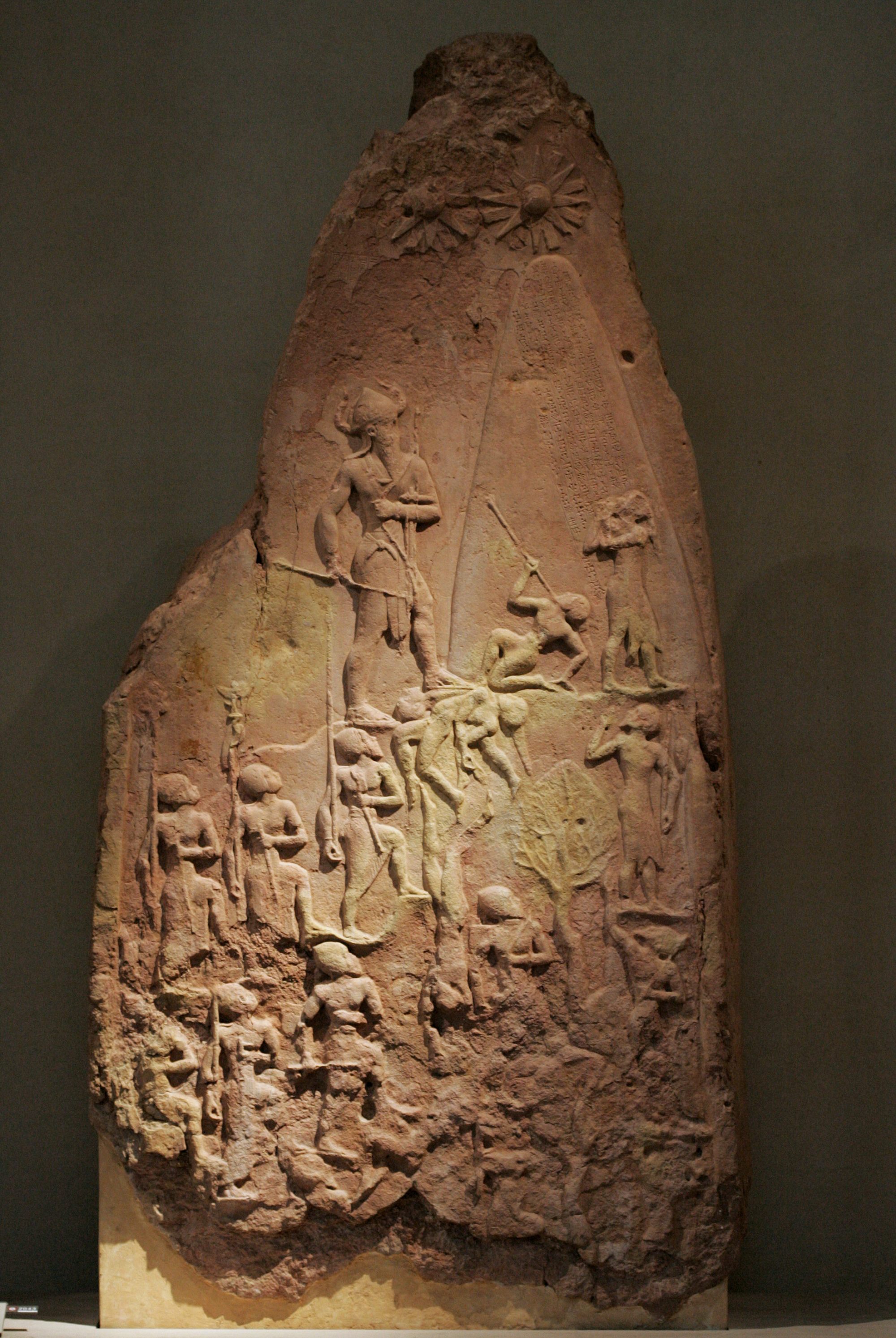
His grandson, Naram-Sin, bull-horned God-King,
King of the Four Quarters, King of the Universe,
Victor over the troublesome highland Lullubi,
Erected a victory stele, an iconic monument
Where he appeared looming huge as a god,
A giant overshadowing a diagonal angle,
Commanding order from the left to right,
Striding over his battling army, imposing on
The heaps of defeated foes falling from cliffs,
Speared and trampled, fleeing in fear of Naram-Sin.
But Naram-Sin pillaged the temple of Enlil at Nippur
And suffered for his sacrilege. Barbarian invaders
Descended from the Zagros mountains east of Ur
Like a plague of snakes and scorpions, like locusts
Ravaging the land, an unbridled horde swarming
Down into the cities of Sumer, sowing disorder
So that couriers no longer carried messages,
Traders and travelers no longer sailed rivers,
And farmers no longer ploughed their fields.
Wild Gutians overran the Akkadian empire,
Grazing herds in gardens wild with weeds,
While on towpaths of abandoned canals
Untethered camels roamed loose and wild.
The Gutians wreaked chaos on civilization;
The city of Akkad was razed from the earth,
Her sacked and burned ruins buried forever,
Undiscovered for all ages.
Lud, patriarch of Hattians, Hurrians, Lydians, and Luwians,
Lived long in Urkesh, in the foothills of the Taurus Mountains.
The sons of Lud married the daughters of Tubal’s dying kings,
To launch the lineage of Hattians, recorded on Akkadian clay
As long-nosed traders worshipping an obscenely fat goddess.
First settling in central Anatolia to build the old city of Hattush
With massive ashlar walls, lofty ramparts, and steep streets,
The Hattians spread into a confederation of rich city-states
Until the Hittites took Hattusha and made it their stronghold,
Impregnable in the snowy plateau, lost in fog and darkness.
Related to the Hattians, the Lydians lived in western Anatolia,
And gained renown as shrewd traders amassing coveted wealth;
Under Croesus, the Lydians minted the first coin currency in gold
And silver, and electrum coins stamped with lion’s head and paw.
The Luwians went west to Arzawa and founded the city of Troy,
Known to the Hittites as the city of Wilusa, a great city of kings,
Raised with cyclopean walls and ramparts to withstand sieges.
They also pacified Lydian principalities embroiled in disputes
With each other and with the Mycenaean Greek colonies.
Some Luwians joined the Dodanim to settle old Hellas,
Mixing with Peleg’s blood lines to breed the Pelasgians,
While others married into the Kittim to birth the Greeks.
An early epic recorded Troy’s fall to a fleet of Hellenes,
An armada of armies led by kings of mythical renown.
Gathered by the winds, the allies assembled at Troy;
They had come to rescue the world’s fairest woman
Whose beauty had launched the first world war
After a wanton Trojan prince had seduced her
To cuckold her husband and take her to Troy,
And so betray her Mycenaean lord and king.
Man for man, the armies battled to a standstill,
Dardanian against Mycenaean, Phrygian against
Cephallenian, Pelasgian against Lacedaemonian,
Thracian against Myrmidon, Trojan against Greek;
Axes clashing with swords, arrows piercing shields,
Javelins hurled at helmets, maces bashing skulls,
Chariots charging infantry, horses rushing spears,
Lowered like a bristling porcupine aimed at a lion;
With many heroes falling and widows mourning,
As if fickle gods played with men and women,
And death fingered the puppet strings of fate;
So the battle raged back and forth across
Ilion’s plains beneath the Trojan walls.
Worn down by bloodshed and losses,
A crafty Greek devised a clever plan
To defeat Troy with cunning and guile
In the gift of a wheeled, wooden horse.
War weary Trojans welcomed this sign
Of ceased hostilities into the city square.
At night, as Troy slept in drunken stupor,
Greek heroes hidden in the hollow belly
Of the Trojan horse opened city gates
To allow the Argive armies to enter
And burn the great city to ashes.
A Luwian remnant sailed to Italy
Led by a surviving Trojan knight
Who later sired ambitious Latins
And bred an empire of iron men.
From Urkesh came the Hurrians
Who, allied with the Akkadians,
Built an outpost of civilization with plumbing in palaces.
Next to Anatolia, in the Armenian highlands, the Hurrians
Built Tushpa, capital of Urartu, on the shores of Lake Van.
One of their kings, Sardur the Second, erected a stele
In four languages, declaring himself:
“The magnificent king,
The mighty king,
King of the universe,
King of the land of Nairi,
A king having none equal to him,
A shepherd to be wondered at,
Fearing no battle,
A king who humbled those
Who would not submit to his authority.”
Invading Hittites and Assyrians
Later overran the Hurrians
Following the fall of the Mittani kings
When they were then hidden to history,
Their name conserved in clay.
Did a remnant flee north
To become the Nakh?
Only God knows.
My last son, Aram,
Was father of the Arameans
And the peoples called Syrians,
Whose son Uz founded Damascus,
Whose son Hul founded Merv in Margia,
Whose son Gether founded Bactrian Balkh,
And whose son Mash wandered east
And was lost in the ice bound mountains
At the Roof Top of the World.
Aram was brought out of Kir to found
The rival trading cities of Ebla and Mari,
Ever at war with each other until conquered
By the Amorites of the Canaanite highlands.
Between Ebla and Mari, the city of Harran
Raised beehive roofs to beckon caravans
Traveling from Mesopotamia to Anatolia
Along the curve of the Fertile Crescent
At the crossroads of mighty empires.
Arpachshad was born to me
Two years after the Flood,
When I turned one hundred years old,
After I had settled in Ur of the Chaldeans.
Arpachshad became the father of Shelah;
And Shelah became the father of Eber,
And Eber became the patriarch
Of the Hebrews,
God’s chosen people.
Two sons were born to Eber.
The name of the first was Peleg,
For in his days the earth was divided
Into continents like rafts drifting on water,
And dispersed from Babel into tongues,
Like the roar of waterfalls across a rift.
Peleg’s twin brother’s name was Joktan,
Father of thirteen sons:
lmodad, Sheleph, Hazarmaveth, Jerah, Hadoram, Uzal,
Diklah, Obal, Abimael, Saba, Ophir, Havilah and Jobab;
Desert tribes trading in beautiful garments, blue fabrics,
And multicolored rugs, kilim, and carpets with cords
Twisted, tightly knotted, and shuttled on large looms.
Joktan’s prolific progeny migrated from Arabia Felix
To North Africa, from the Mashrek to the Maghreb,
Fathering the nomad Bedouin tribes of oral poets
Who bred magnificent, fire breathing, war mares.
Welcoming strangers, then raiding their kinsmen,
These herders of camel caravans trekked sands
In lands of cumin, myrrh, frankincense, and gold,
And wove the fine wool of lamb, sheep, and goats
Into clothes, cloths, and black haired desert tents.
Some of the nomadic tribes of Arabs and Sabeans,
Settling in the old kingdoms of Sheba and Thamud,
Built cities in Hadramawt with high-rise apartments.
On high pinnacles and crags, under massive cliffs,
White-washed mud-brick buildings rose in towers,
Gleaming like decorated cakes in the setting sun,
With red dunes flowing from the Empty Quarter
Swallowing Ubar’s bazaars under their sands;
And the Well of Hell, like a one-eyed cyclops,
Swallowing sleepy caravans traveling at night.
Over the ruins of deserted cities, desert kings
Built the port city of Sumhuram for free trade
Between goods from the interior and far India,
Becoming a people of great fortune and fame.
Now their settlements extend from Mesha
As you go toward Sephar,
To the eastern hills.
These my sons, the sons of Shem,
According to families and languages,
By their lands, according to their nations.
Other sons and daughters were born to us,
To my brothers and their scattered children,
During my six hundred long, tiring years on earth.
Migrations blurred bloodlines and mixed gene pools;
Identities became distinct and eager nations emerged
With imperial ambitions to make for themselves a name,
Many claiming glorious descent from Noah and his sons.
Self interests moved peoples into God-moved directions;
Ancient clans and tribes resisted invasions, fought or fled,
Finding refuge in hidden valleys or sailing to distant lands,
Or were sold as slaves and resettled in conquered colonies.
The races of men shifted colors like a rainbow in the clouds:
Black, brown, and blue, pink, white, and yellow; men clashed
In wars, fought against neighbors, and betrayed kin loyalties;
Empires rose and fell like waves of the sea crashing on cliffs,
Allegiances shifted, friends became foes, and the colors ran
Red with blood.
Time and time again men were taught
These timeless truths:
“No king is saved by the size of his army;
No warrior escapes by his great strength.
A horse is a vain hope for deliverance;
Despite all its great strength it cannot save;
But the eyes of the Lord are on those who fear Him,
On those whose hope is rooted in His unfailing love.”
From heaven the Lord looks down and sees all mankind,
From His dwelling place he watches all who live on earth.
From His throne His eyes seek those who search for Him;
He who forms the hearts of all, who considers all they do,
He who holds peoples and nations in the palms of his hands,
He who sits enthroned above the circle and vault of the earth,
Above the plains where men scurry and leap like grasshoppers,
Above the hills where men build their stone cities and temples,
Above the rivers, lakes, and seas where men trade treasures;
He raises the poor from dust to sit on iron thrones of power,
He turns lofty cities to dust and blows away kings like chaff,
He breaks the warrior’s bow and loosens arrows on his foes,
To guide mankind towards salvation,
To deliver mankind from damnation,
To judge mankind for rebellion and sins.
So God foiled the nation’s plans, the people’s purposes
Were thwarted, while the Lord’s plans stand firm forever,
The purposes of his heart faithful through all generations;
Plans to bless and not to curse, to prosper and not to harm,
To offer hope and a future for the nation that chooses God.
“Blessed is the nation whose God is the Lord,
The people He chose for His inheritance.”
“May your covenant of love be ever with us, Lord,
Even as we anchor our steadfast hope in you.”
So God moved the nations of mankind
Across continents, seas, and oceans
To glorify His Name
In the fullness of time and history’s end.
Strange, lost names came back to us from afar
From shipwrecked sailors and caravan traders
Returning with thrilling and mysterious tales of:
The Basque and Gascon cave painters of Cantabria,
The Dravidians and Australoids of Ceylon and Celebes,
The Khoisan and Pygmy hunters of savanna and forest,
The Bantu nations of mighty warriors and cattle herders,
The Laal speakers fishing the floating islets of Lake Chad,
The Tobou clans hiding in caves along Saharan trade routes,
The Ainu, Yakut, Chukchi, Yupik, Inuit of northern, snowy lands,
The Polynesian wayfinders who sang their path to island stars,
The Ona, Yahgan and Alacaluf at the world’s uttermost edge,
The Olmec, Caral, and Chavin who built stepped pyramids,
The Guarani who lived in a paradise called Yvy Maraney,
And the Dine, the real people of a grand, golden canyon.
There were others whose names have been lost to time,
Whose names are only remembered by God.
There too were myths of men in distant lands,
An empire on a continent sunk into the ocean,
An ancient, advanced civilization of lost Atlantis,
Embellished by philosophers to warn against hubris.
There were tales of cyclops, centaurs, satyrs, fauns,
Terrible beasts, half human, half animal, and women
Fierce in war who cut off their breasts to better fight.
There were monster races who lived in the Antipodes,
On the opposite side of the world where the sun rises
While setting in our west, with feet facing backwards.
Some had one eye in their forehead, others no head
Who see through their shoulders; some with two feet
And one leg, fleet-footed, lying down on their backs
To shade themselves with their feet; double-sexed
Hermaphrodites and rare, single-sexed androgynes,
Strange Fall fruit shunned and mocked by blind men.
Other oddities and rarities, born with shriveled limbs,
Contorted, deformed, twisted, and misshapen bodies,
With double upper and single lower half of a human;
With two heads, two chests, and four arms
On one torso and two legs, like normal men;
With tender hearts and thoughts that longed to love,
Offered evidence of one diverse humanity descended
From a common ancestor, from Adam to Noah’s sons.
Sharing a common flesh, rational mind, and moral bent,
Men bent knees to acknowledge a compassionate God –
The Lord of all mankind.
At the first light of a rosy fingered dawn,
The parliament of birds assembled to seek a king,
Filling the skies with feathers and crowding the trees
With the curious and intent, with predators and prey,
With sunbirds and sugarbirds, rollers and buntings.
They first trilled paeans of praise to the Lord
Then warbled hymns of thanksgiving
To Him who had saved them from the Deluge.
Seed-eaters, worm-pullers, waterfowl and birds of prey
Consulted with the hoopoe at their conference of fowls.
“We must find a king to save us,” said the sparrow.
“Look at the condition of the world,” spoke the owl.
A chorus of consent erupted from the congregants,
“Discontent! Unhappiness!”
“Anarchy – rebellions – wars!”
“Plagues and diseases!
“Bitter battles over land, water, and food!”
“Polluted air! Poisoned water! Toxic earth!”
“Droughts are killing crops, fires devour the hills!”
“Floods destroy towns and sweep away villages!”
“The Sea Peoples are here, their warships arrived!”
“Cities are sacked, palaces burn, bodies in streets!”
“The sky is falling, the sky is falling!”
“I fear we are lost!”
The thrush asked, “Who will save the nations from themselves?”
Then the hoopoe answered, “I know a king who can save us.”
And the bulbul averred, “The nations await the Son of Man.”
REFERENCES:
The Victory Stele of Naram Sin https://upload.wikimedia.org/wikipedia/commons/d/d8/Victory_stele_of_Naram_Sin_9068.jpg
Genesis 10
Psalm 33:10-22
Isaiah 23:3
Ezekiel 27:24; 38:6
Acts 17:26-29
2 Chronicles 16:9 NIV [9] For the eyes of the Lord range throughout the earth to strengthen those whose hearts are fully committed to him. You have done a foolish thing, and from now on you will be at war.”
Augustine lists 73 nations from Noah: 15 by Japheth, 31 by Ham, 27 by Shem.
Augustine, City of God, Book Sixteen, 3. Of the generations of the three sons of Noah.
Augustine, City of God. Book Sixteen, 8. Whether certain monstrous races of men are derived from the stock of Adam and Noah’s sons.
Augustine, City of God. Book Sixteen, 9. Whether we are to believe in the Antipodes.
“The men of Crete are evidently grateful for the grace and adventure that women give to life, for they provide them with costly means of enhancing their loveliness. The remains are rich in jewelry of many kinds; hairpins of copper and gold, stickpins adorned with golden animals or flowers, or heads of crystal or quartz; rings or spirals of filigree gold mingling with the hair, fillets of diadems of precious metal binding it; rings and pendants hanging from the ear, plaques and beads and chains on the breast, [p.9] bands and bracelets on the arm, finger rings of silver, steatite, agate, carnelian, amethyst, or gold. The men keep some of the jewelry for themselves; if they are poor they carry necklaces and bracelets of common stones; if they can afford it they flaunt great rings engraved with scenes of battle or the chase. The famous Cupbearer wears on the biceps of his left arm a broad band of precious metal, and on the wrist a bangle inlaid with agate. Everywhere in Cretan life man expresses his vainest and noblest passion –the zeal to beautify.” From Will Durant, The Life of the Greeks. New York, NY. Simon and Schuster, 1939. http://www.noteaccess.com/APPROACHES/AGW/Aegean2.htm
Comparisons with other ancient European farmers show that agriculture was brought to Iberia by the same migrant groups that introduced it to central and northern Europe. These pioneers expanded from a homeland in the Near East, sweeping across Europe about 7,000 years ago to usher in the period known as the Neolithic. … One of these movements occurred in the Bronze Age, when pastoralists from the Steppe – on the eastern periphery of the continent – travelled west en masse. This migration probably spread Indo-European languages across Europe, affecting the central and northern parts of the continent to a greater extent than the south. While the genomes of French and Spanish individuals showed evidence of this eastern genetic input, those of Basques did not. “Ancient DNA cracks puzzle of Basque origins” http://www.bbc.co.uk/news/science-environment-34175224
https://phys.org/news/2016-06-farming-europe-people-modern-day-greece.html
https://www.penn.museum/sites/expedition/black-sea-coastal-cultures/
https://www.icr.ro/pagini/the-archaeology-of-the-danube-delta
https://www.archaeology.org/issues/220-1607/features/4560-rites-of-the-scythians
https://blog.britishmuseum.org/introducing-the-scythians/
http://www.heritageinstitute.com/zoroastrianism/saka/
https://indo-european.eu/y-dna-and-mtdna-maps/
https://indo-european.eu/y-dna-and-mtdna-maps/haplogroup-r1b-m269/
https://www.academia.edu/45055541/Seima_Turbino_Culture_and_the_Proto_Silk_Road
https://www.nytimes.com/2021/10/20/science/horse-domestication-russia.html
https://phys.org/news/2021-05-ancient-dna-reveals-bronze-age.https://greekreporter.com/2021/09/10/griffin-warrior-ancient-greece/amp
https://phys.org/news/2017-08-civilizations-greece-revealing-stories-science.html
https://www.ancient.eu/article/449/minoan-jewellery/
https://www.livescience.com/27955-knossos-palace-of-the-minoans.html
https://www.creteisland.gr/de/crete/history/ancient/7-ancient-cities-of-crete
https://www.thoughtco.com/pottery-types-in-ancient-greece-118674
https://www.thoughtco.com/time-periods-of-pottery-ancient-greece-118838
http://phoenicia.org/trade.html
http://www.phoenician.org/origin_of_phoenicians.htm
https://www.aramcoworld.com/Articles/April-2021/Could-Phoenicians-Have-Crossed-the-Atlantic
http://www.setterfield.org/Havilah.html
http://www.deathreference.com/Gi-Ho/Gilgamesh.html
http://trobisch.com/david/wb/media/material/Gilgamesh%20tablet_AW.pdf
https://www.ancient.eu/image/7114/inscription-of-the-urartian-king-sarduri-ii/
http://www.reshafim.org.il/ad/egypt/political_marriages.htm
http://biblicalstudies.org.uk/article_covenant.html
https://en.m.wikipedia.org/wiki/Khazar_Correspondence
https://youtu.be/meex6Y4xdos – BBC Documentary on the Danakil Desert
http://www.worldwildlife.org/ecoregions/pa0906
https://thepharaohofabraham.wordpress.com/tag/hatshepsut/
https://spatialexperiments.wordpress.com/2016/09/18/bedouin-tents-black-wool-and-a-cactus/
https://orbi.ulg.ac.be/bitstream/2268/164042/1/ID%2312530_Final2.pdf
https://s3.amazonaws.com/academia.edu.documents/36705592/NAR_Hafsaas-Tsakos.pdf?
https://en.m.wikipedia.org/wiki/Atlantis_of_the_Sands
https://www.omanobserver.om/article/26396/Local/sumhuram-frankincense-port-of-yesteryear
https://web.archive.org/web/20111025092125/http://saharasafaris.org/hassaneinbey/ngs1924article.htm
https://smarthistory.org/running-horned-woman-tassili-najjer-algeria/
http://humanpast.net/art/art7k.htm
https://www.temehu.com/Cities_sites/germa.htm
https://www.temehu.com/imazighen/berbers.htm
https://www.archaeology.org/news/7349-190205-caucasus-gene-flow
http://www.bbc.com/news/science-environment-34175224
https://www.ancient-origins.net/artifacts-ancient-technology/first-known-author-0011509
https://www.newscientist.com/article/dn24988-humanitys-forgotten-return-to-africa-revealed-in-dna/
https://mathildasanthropologyblog.wordpress.com/tag/rock-art/
https://africanrockart.britishmuseum.org/
https://africanrockart.britishmuseum.org/country/chad/niola-doa/
https://africanrockart.org/ngg_tag/messak-plateau/
https://africanrockart.org/ngg_tag/messak-plateau/nggallery/page/2
http://www.bradshawfoundation.com/africa/oldest_art/index.php
https://www.youtube.com/watch?v=HD_Ot2GaCXo
https://www.youtube.com/watch?v=8Y4DddMXsHk
https://www.sciencedirect.com/science/article/pii/S0002929716304487
https://www.temehu.com/sahara-prehistoric-rock-art.htm
https://faroutmagazine.co.uk/oldest-song-in-the-world-written-3400-years-ago/
https://www.ancient.eu/article/1079/trade-in-ancient-egypt/
https://www.ancient-origins.net/ancient-places-africa/where-was-mysterious-kingdom-yam-005524
https://academic.oup.com/qje/article/134/3/1455/5420484
https://www.archaeology.org/issues/430-2107/features/9752-ugarit-bronze-age-archive
https://mail.google.com/mail/u/0/#inbox/FMfcgzGkZkXNNGqhkKtZdcsTljdXNRJH?projector=1
https://www.atlasobscura.com/articles/yemen-well-of-hell-cave-explored
Periplus of the Erythraean Sea. https://sourcebooks.fordham.edu/ancient/periplus.asp
The Coronation of Ur-Nammu, William W. Hallo, Journal of Cuneiform Studies, Vol. 20, No. 3/4 (1966), pp. 133-141, Published by: The American Schools of Oriental Research DOI: 10.2307/1359648, Stable URL: http://www.jstor.org/stable/1359648
M. Van De Mieroop (2008). A history of the ancient Near East. Malden, MA: Blackwell Publishing
Susan Wise Bauer (2007). The History of the Ancient World: From the Earliest Accounts to the Fall of Rome. New York, W.W. Norton.
Arthur Evans (2006). Ancient Illyria: An Archaeological Exploration. I.B. Tauris, London.
A.S. Kline, The Parliament of Fowls, Geoffrey Chaucer http://www.poetryintranslation.com/PITBR/English/Fowls.htm
Farid ud-Din Attar, The Conference of the Birds, Peter Sis, 2011, Penguin Press, http://www.npr.org/books/titles/141694033/the-conference-of-the-birds#excerpt
https://eoimages.gsfc.nasa.gov/images/imagerecords/0/885/modis_wonderglobe_lrg.jpg
 The Covenant of love