Exposed in the light of truth we anticipated God’s judgment.
The arraigned stood before the magistrate awaiting the verdict.
The dark dragon lord, now revealed, received his sentence:
“Because you have done this,
Cursed are you more than all cattle,
And more than every beast of the field;
On your belly you will go,
And dust you will eat
All the days of your life;
And I will put enmity
Between you and the woman,
And between your seed and her seed;
He shall bruise you on the head,
And you shall bruise him on the heel.
How you have fallen from heaven,
Morning star, son of the dawn!”
He who wanted to hurt God only hurt himself,
His black arrow’s aim redounded to his heart;
He who fell from heaven’s heights to roam earth,
How he was brought down to the depths of the pit!
Laid low in the realm of the dead, the abyss of Sheol,
The kings of nations condemn, ‘You conspired to be God,
You aspired to all power, but now you have become like us.’
Below all creatures he was cursed to crawl in mud and dust,
Cursed to dwell with maggots, worms, and rotting corpses,
Cursed to fall from a proud erect position and slither prone,
To writhe in knots and snake his way in serpentine paths,
To stalk his prey with stealth and a spitting split tongue,
To submit to the swaying moves of a charmer of snakes.
He will war with all women and like the weasel that he is,
He will steal their eggs and abort the unborn out of spite;
His seed will sow discord and division in woman’s seed,
But her seed will bruise his head when he bites his heel.
On the day of battle the woman’s champion will prevail,
On the day of judgment evil’s doom will be sealed in hell;
On that day the choicest junipers and tallest cedars
Of Lebanon will shout aloud in triumph
And rejoice that no one comes to cut them down.
I felt a visceral recoil at the slithering snake, hypnotic
Fear from the elemental presence of dust and darkness
That would fill some future daughters with hysteric dread,
While others would conjure a show and cultivate dark arts
Fixed on the serpent’s spells, charms, potions, and poisons.
When the Lord God spoke to me, his words pierced my soul;
The sentence for sin tolled like thunder on a calm day:
“I will make your pains in childbearing very severe;
With painful labor you will give birth to children.
Your desire will be for your husband,
And he will rule over you.”
God gave me free will and I chose to disobey His command.
I wanted to be like God, to have controlling rights over my life,
But life rights require wisdom, responsibility, mercy, and love.
My disobedience had punitive and redemptive consequence:
The painful punishments refined me as a crucible of gold,
The guilt goads and conscience pricks led me to reflect
Deeply on my motivations, the twisting paths of my heart.
God gave me the gift to bear children with blood and pain;
In suffering birth I learned submission and grew sanctified,
In trials of barrenness and miscarriage my faith was tested.
Since I had wanted to be like God, He made me a servant,
An appropriate and commensurate sentence for my pride.
I sought to please my spouse, strove to serve my mate,
Quarreled with my husband and ached for his gentle touch,
Found purpose in children and merited favor with compassion,
Tended the hearth, tilled the garden, and toiled in the stony soil,
Fetched water from the well and gathered wood from the forest,
Wove, sewed, knitted, stitched, spun, crocheted, and embroidered,
Made clothes and cooked meals, washed clothes and cleaned pots,
Bartered shrewdly in the market, uttered proverbs, taught traditions,
And fellowshipped with women weaving tapestries in a circle of life.
I would dedicate my energies to knit individual threads into family;
Patience would be my virtue, fear my life, and caution my strength.
Constrained by the curse, I vowed to quell my rebellion and submit
My will to His, to fear the Lord my God with wisdom in all my ways;
Then my children would call me blessed and my husband love me.
Turning last to Adam, the Lord God delivered the doleful decision:
“Because you listened to your wife
And ate fruit from the tree
About which I commanded you,
‘You must not eat from it,’
Cursed is the ground
Because of you;
Through painful toil
You will eat food from it
All the days of your life.
It will produce thorns and thistles for you,
And you will eat the plants of the field.
By the sweat of your brow
You will eat your food
Until you return to the ground,
Since from it you were taken;
For dust you are
And to dust you will return.”
As covenant head of the family
Adam failed to keep God first in faith.
He listened to me and disobeyed God’s commandment,
He ate the fruit from the tree God commanded us not to eat,
A command that was for our good, to protect us from all evil.
Instead, we had chosen to covet what we could not have,
We had taken what was not ours, we had tried to conceal
Our sin, our guilt, our shame from our all-seeing Creator;
And so had reaped our just reward, the penalty of death.
To covet, to take, to hide, and so to die; this progression
Has been the pattern of sin for all generations of sinners,
Of which none have escaped the curse of our original sin,
Save the sinless seed who will come to save us of our sin.
Because we came from dust, we will cleave to the ground.
We will grow our clothes from hemp, cotton, and linen flax,
But moths will eat our threads and finery will tear to rags.
Our labor will now turn to toil and our triumphs all will spoil.
The seed that we sow will be choked by thorns and thistles,
The wheat that we reap will rot with rust, wilt, bunt, and smut.
The bread that we eat will be baked with sweat from our brow.
We will plow the unyielding soil, then scatter seed in the sun,
And while we wait, chase away the birds and weed the tares,
For our fields will not yield their fruit without travail and cares.
Then when the time is right we will scythe the harvest,
Thresh the grain and winnow the chaff,
Then grind the grain and mill the flour.
Before our tongue will ever taste fresh bread
We will mix salt, oil, water, sugar, and yeast;
We will knead the dough and watch it rise;
Before our teeth will ever chew bread
We will bake it in the sweltering heat
Of a kiln;
And mercy will reward our wait
When we bite into the warm bread.
Then we will bless the broken bread,
We will honor the guest with bread,
We will not defile the fallen bread,
And with bread we will nourish all;
A blessing will rise from the curse.
Because Adam listened to me
And ate from the forbidden fruit,
We will surely die –
Return to the cursed ground we came from;
Earth to earth, ashes to ashes, dust to dust,
From dust we came, to dust we shall return.
The great soul doctor rightly diagnosed our condition:
“The cause of blessedness is adherence to God
And departure from God causes injury and misery.”
The mutable, made out of nothing,
Fell from the immutable that created it.
The ability to choose not to sin or sin,
And the possibility to not to die or die,
Passed to the inability to not sin
And the inevitability of death.
“Posse non peccare” became “non posse non peccare”.
But that was not a prescription, only a pronouncement
For a dire and mortal condition with no salve or cure.
We were cut off from our Creator and self-deceived,
Separated in spirit from each other and sin-enslaved,
We uprooted from our environment in a soul-psychosis
That masked with exploitation our grotesque alienation,
Applying cloying scents to hide the stench of our dying;
Guile had fathered guilt and guilt had fostered disguise.
We had donned masks of deception and cloaks of lies,
We had perverted our priesthood to follow false gods,
We had lost innocence and the dominion over nature,
We had disobeyed God’s good law and suffered loss,
We had rejected the author of life and reaped death.
Dead to God, dead to ourselves, dead to each other,
We had become like gods, knowing good and evil,
But in our behavior descended lower than the beasts.
What small reward to know that we had acquired science
At the cost of knowing God; knowing how without the why.
We could make tools and harness the wind, water, and fire,
But we could not control our lusts, rages, and desires.
Our innermost being emptied of divine breath,
We lit candles in the vast cave of our darkness,
Letting the winds of willfulness blow out the light.
The trauma of our loss haunted us with shadows,
Our spirits depressed with guilt, shame, and fear.
We consumed garbage to fill the bottomless void,
Replacing God with idols of id, ego, and superego,
And substituting stuff for spiritual wisdom and wealth.
A collective amnesia clouded our thoughts, swallowing
Up memories of paradise and leaving lingering longings.
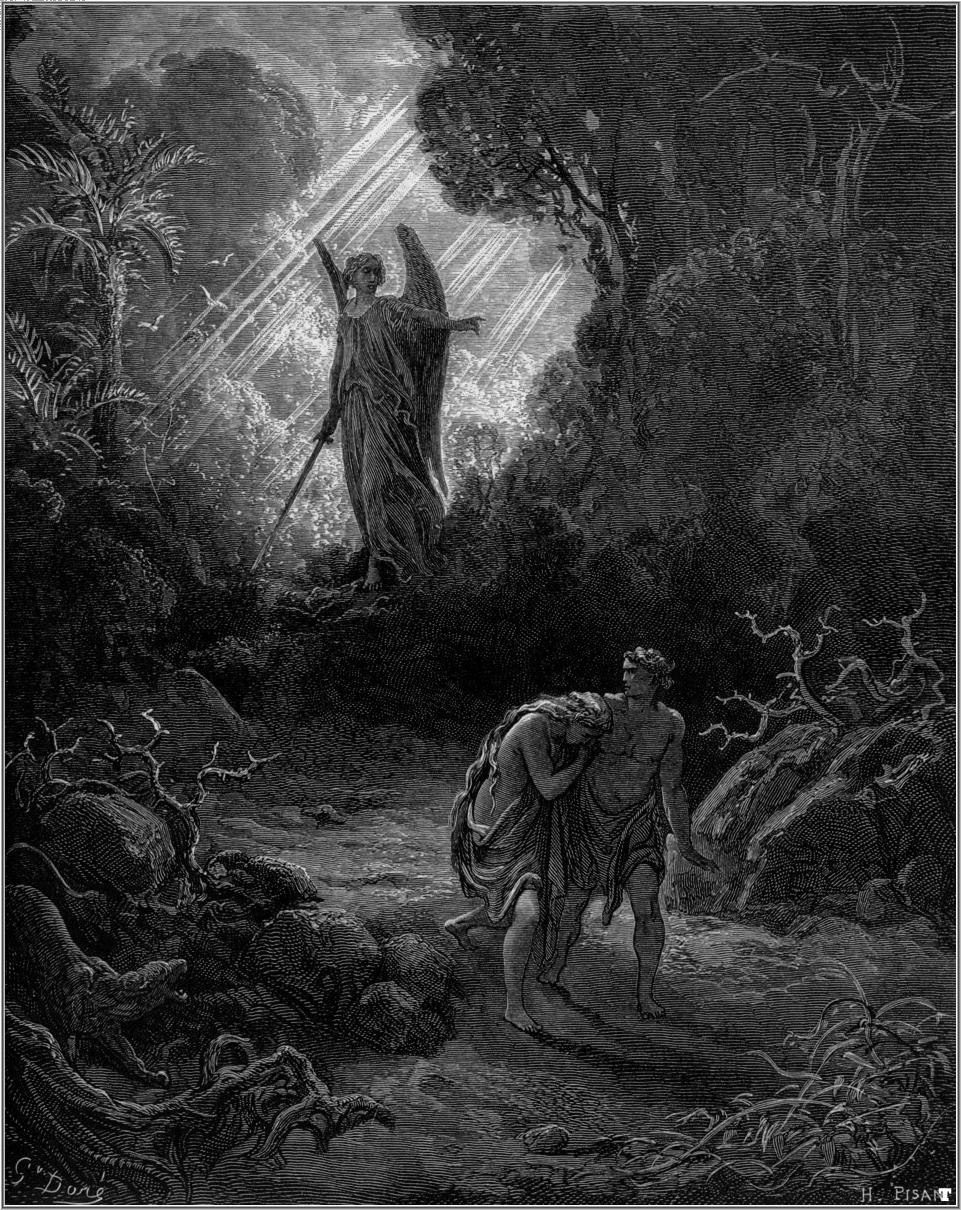
As we walked away from the garden, an angel appeared,
A cherubim camped at Eden’s east gate to bar our return,
Waving a flaming, flashing, fiery sword in every direction
To barricade the tree of life, lest we taste immortality,
And so prevent an eternity of separation from God,
And thus preserve the hope of a future redemption.
As we looked back, our forest home froze into a wall
Choked with creeping, coiling, climbing tendrils of vines
That petrified into a jungle of jade, emerald, and malachite.
Then the foliage exploded in fire, branches swirled with flames,
The leaves like embers – red, yellow, orange – fell to the ground,
And a cold north wind rattled the border sentinels like skeletons.
A wall of ice advancing from the north, a giant glacial palisade
Creeping towards paradise, menaced Eden’s earthly delights,
Threatening to entomb the world in endless winter’s ice age.
But God did not abandon us to our doom. He clothed us
With garments of skin, with hides to clothe folly with fur,
And warm us against the ravages of unforgiving winters.
It felt strange to put on the pelt of what had been living,
Now sacrificed to cover over our nakedness and shame.
The fig leaves we had sown together to cover our guilt
Were insufficient; our labors to hide shame to no avail.
God revealed that blood must be shed to forgive sins,
A requirement He alone could fulfill with His sacrifice.
This gift of God’s grace provided an atonement for sin,
Propitiation to appease wrath, and an expiation of guilt.
God’s abiding, eternal covenant of love cloaked our sin
With His holy righteousness and His all forgiving mercy.
We, born naked, suffering hatred, assumed the sacred;
Our divorce from God and each other annulled with love.
It was as if God Himself had spread his skirt over our sin
And covered with His garments of grace our naked skin.
He became our Father in heaven, enfolding us as family,
Embracing us as a guardian and redeemer, our master
And Lord, our protector in storms, and our guide in life.
From then on we began to institute sacrifice in worship
As we organized our exodus out of the garden of Eden.
Which way to go? Which of the four rivers to follow?
The Pishon to golden Havilah, the Gihon to Cush,
Or the Tigris and Euphrates to the east of Eden?
Crossing the waters I heard a buzzing in my ear,
Then felt a sharp pain bite deep into my hand,
And I saw a winged insect pierce my skin,
And suck my blood.
When I swatted the creature
A red stain marked my flesh.
Death had come to life.
Exiled from paradise,
Refugees from Eden,
Wanderers on earth,
We first sheltered in caves,
Raised hogans on the plains,
Built dolmens in the mountains,
Assembled wigwams in the woods,
And erected yurts across the steppes.
At first we foraged for food,
Gathering wild fruits and nuts,
Picking berries and mushrooms,
Raiding bee hives for sweet honey,
Stealing the eggs from goose nests,
And eating grass, flowers, and leaves.
We learned to domesticate wild animals:
Harnessing oxen for plowing and pulling;
Donkeys, elephants, llamas, and alpacas,
As beasts of burden, for their fur and wool.
We bred chickens, ducks, pigs, yaks, cows,
And followed herds of horse, cattle, camels,
And large flocks of grazing goats and sheep.
We drank milk from hollowed horns, churned
Butter, and fermented curds into hard cheese.
Dogs and cats became steadfast companions,
Sharing our food as pets and ridding us of pests.
We made tools by chipping flakes off flint stones,
Crafted sharp knives with shards of obsidian glass,
And turned ostrich eggs and gourds into containers.
At first we feared fire and lightning,
The burn of loss throbbing fresh scars,
Remembering the flaming sword barring
The dream of a return to the Garden of Eden;
But we learned to master fire contained in pots,
Fanned flint-sparked flames into glowing embers,
And built clay ovens to boil water and bake bread.
We fished streams and rivers, followed desert wadis
To oases, and found springs bordered by royal palms.
When we came to the shore of the endless, windy sea
We learned to comb the beach for shellfish, build boats
And weave nets to cast upon the waters and haul in fish.
We wove weir baskets to collect rich bounty from the sea,
And trapped herring with our hands when the tide ran out.
We bound walrus hides to driftwood frames for an umiak,
Carved dugout canoes and lashed poles to bamboo rafts,
Rowed in leather coracles, and filled cloth sails with winds.
Did we hunt and kill prey? Reluctantly, when hunger led us,
We stalked and trapped small animals and ate the locusts
That settled on our garden and stripped the orchard trees.
Sometimes, large hunting parties went out to track game,
Catching antelope or herding mammoths into hidden pits,
Killing with spears tipped with the ivory carved from tusks.
Much later we learned to cull the weakest from our herds,
Eating only the clean animals after they were ritually bled
And offered in sacrifice to atone for sin and appease God;
But the slaughter and butchering were hidden far from me.
Our consciences were not yet blunted and dulled by death,
And the sight of blood made me swoon when flowing free.
Adam developed an aptitude for the science of medicine,
And I for the healing arts. Relying on the body’s powers
To recuperate health with food, fasting, fitness, and rest,
We entrusted our science to faith in God’s power to heal
In answer to our fervent prayers, supplications, and pleas.
We studied the properties of plants, palliative and curative,
Learned herbal lore, prepared tinctures and potions, brewed
Teas and infusions, dried weeds and flowers, and burned oils
Essential to specific ailments, effective in their scents and airs.
We collected the white tears of mastic dripping from resin trees,
And chewed the soft gum to ease digestion and sweeten breath.
We learned to add leafy herbs and spices extracted from roots
As healthy condiments to our foods, and for our general health,
Seasoning bland and tasteless vegetables with aromatic taste:
Sweet vanilla, hot pepper, smoky paprika, sharp dill, fresh mint,
Pungent savors of tarragon, turmeric, ginger, nutmeg, and sage,
Spicy accents of cardamom, caraway, cumin, cloves, and chives,
Earthy allspice, nutty oregano, piney rosemary, and musky mace,
Garlic and parsley, fennel and onion, coriander and cilantro, basil
And bay, cinnamon and saffron, lime and thyme and lemon zest,
Infusing aromas and flavors and textures to tickle the senses of
Sight, smell, touch, and taste. We so enjoyed eating our meals!
When we discovered salt by following deer to salt licks, our lives
Transformed. We salted fish and cured meat to preserve stores,
And reaped benefits of blood circulation and improved digestion.
We sprinkled salt into the flames and onto the flesh of sacrifices
To symbolize God’s grace and celebrate His purification from sin,
Administering perpetual love in an unbreakable covenant of salt.
We learned anatomy, the functions of the four humors in organs,
Working together to mend wounds, set fractures, apply poultices,
Mix concoctions, diagnose diseases, and prescribe prophylactics.
We developed tools for hunting, tools for agriculture, tools for work:
Ingenious spear throwing atlatls carved from wood, bone or ivory;
Copper adzes and ash-handle knives with chert blades; yew bows
With sinew strings and hickory-shafted arrows, flint tipped, bound
With falcon fletching to drive the darts true and straight to the prey.
We wove grass bags to gather fruit, made bark baskets for berries,
Peeled, split, chewed and coiled reeds, roots, and rushes into rope,
And stuffed straw in bear hide boots to smooth the rub of running.
We applied technology for all textiles, devised weaving techniques,
Twisted fibers into strings wound onto round spindles with whorls,
Wove yarns of wool, flax, hemp, cotton, silk, and linen with looms,
Threading weft over warp with heddles into weaves of twill fabric;
Stitched leather strips for harnesses, sewed felt patches for hats,
Soaked rawhide skins in tanning vats to fashion shoes and belts,
Tooled deer buckskin into hard quivers and soft undergarments,
Dyed linen, wool, and cotton cloths in madder, woad, and weld,
And designed appropriate clothes from fabrics, furs, and hides.
In the heat of summer the men wore loincloths and the women
Tailored short tunics; for the winter cold we embroidered robes
And cut fur coats to keep warm and to dress status in fashion.
We adorned ourselves with amber teardrop earrings, beaded
Bangles or bracelets with shells, pebbles, feathers, or bone,
And wrapped our heads with colorful ribbons and turbans.
Men and women more vain painted their faces and bodies
For beauty: kohl around the eyes, henna patterns on hands,
Stripes on cheeks, or sheeted in white mud like spirit ghosts;
Some even pricked their skin with pins and painted in tattoos
To embellish and emboss their bodies with fearsome designs,
Violating with violence the natural grace of God-given beauty.
We mined gold from veins in rocks and nuggets in river beds,
Hammering the malleable metal into lacy, filigree ornaments
Encrusted with prized diamonds, gems, and precious stones.
Much later, we discovered how to refine and smelt metal ores,
Crafting useful artifacts from copper, silver, tin, iron, and lead.
We quarried rocks with wedges in fissures and rolled boulders,
Learning to dress and fit stones and build tall walls and towers.
We timed seasonal sowing and harvesting of crops and feasts,
Erecting rows and stands of menhirs aligned to celestial gyres.
We felled trees for lumber, hauling the logs, hewing the timbers,
Sawing the beams, and carving the poles to build warm homes
Creaking in winter storms and crackling with chimney hearths.
We built houses in forests and bridges over streams with tools
To frame tusked joints of mortise and tenon round water wells,
And join wooden slats into chairs, tables, benches, and boxes.
In the deserts, we molded mud bricks baked hard by the sun,
And built adobe houses with windows ajar to cooling breezes.
We carried goods in oxen-yoked carts on tall, wooden wheels
Rotating around greased axles driving in revolutions of motion.
We loaded donkeys and mules with hay mounds and kindling,
Reined dogs to sleds tracking through the frozen forest snows,
And lashed our laden bundles to the humps of ruminant camels.
We galloped steeds across endless steppes, yelling to the wind,
And milked mares to ferment refreshing drinks in goat bladders.
We stored cereals in stone granaries and conical clay amphoras,
Ground grains in marble querns, mashed with mortar and pestle,
And decorated cylindrical ceramic urns with spirals and arrows,
With whimsical patterns on pottery vessels, repeating designs
Glazed on spherical earthenware dishes, fired in hot clay kilns,
Tempered by cool night air, and burnished bright with a pebble.
We carved reindeer with flint knives on wooly mammoth tusks;
On reindeer antlers we sculpted wooly mammoths and hyenas,
And made our tools from wood, bone, stone, sinew, and straw.
We painted aurochs, ibex, horses, and bison on cave canvases,
Depicted deer in ochre, bears in umber, lions in charcoal and chalk.
Blowing red pigment powder to stipple in stencil our splayed hands,
We decorated the stone walls of our cave temples with bright art,
And engraved elephants, crocodiles, and fighting cats on rocks
To envision our dominion over the creatures of God’s creation.
We abstracted our thoughts with lines, circles, ovals, triangles,
And simple symbols to explore mysteries and express secrets,
Struggling to conquer the divide between thought and speech.
In the river valleys where the rich black soil yielded to the plow,
We planted five grains, tamed wild peas, carrots, leeks, beans,
And other vegetables, and reproduced remembered orchards.
Channeling mountain streams to irrigation canals and qanats,
We cultivated barley, millet, sorghum, pulses, rice, and spelt,
Raised fields of cane and beets, refined molasses into sugar,
Sowed emmer, einkorn, durum, and hardy varieties of wheat,
Harvested teff, rye, maize, oat, amaranth, quinoa, and chia,
And bundled the reaped sheaves into bales and haystacks.
We learned to beat the stalks on the ground to thresh grain,
Throw the grain to the wind to winnow the chaff with a fork,
And grind the grain on round millstones into flour for bread
To feed expanding families, clans, communities, and tribes.
To celebrate plentiful harvests our men brewed barley beer;
Intoxicated, they danced and feasted for days and nights.
The rocky uplands we left wild for livestock to graze free,
Watched over by herders and shepherds — our children.
Before farmers and pastoralists were divided into tribes,
Before tensions arose from the rivaling factions of labor,
We sacrificed our work as votive offerings of veneration.
What began in Eden as the cultivation of a worship cult,
Praising God for His grace given freely and freely gained,
Grew into a culture of cultivation, a means to gain grace.
The burden of sin cast a pall over the purity of our piety,
And joy faded in the fever of toil and hardscrabble work.
We sowed to reap a harvest, cajoled God to bless crops;
Celebrating the fruit of our efforts, we grew self-reliant.
Applying judgment to discovery we acquired wisdom,
Took pride in our work and worked hard to be fruitful;
Breaking hard ground with our muscles and groans,
We turned God’s curse into a measure of success,
Turning brutish survival into productive economy.
With resourceful minds applied to better our lot,
We entrusted our lives to God’s merciful grace,
Worshipping Him with our first-fruit offerings;
And He prospered us with many blessings.
In the fulness of time,
Adam covered me
With a covenant of love
And he knew me,
And I conceived and bore him many sons and daughters.
Enfolded in each other’s arms, whispering our hearts’ love,
Melting into mankind’s first kiss, a softness of pressed lips,
Delighting in the heat of our passion, in our loins enflamed,
Making love rooted in creation and flowering in covenant,
Consecrated in marriage and blessed with nuptial vows,
Our unions were our brief joy, an embrace of intimacy,
An enjoyment of God’s gift, two bodies in one flesh
Bound in the thrill and tremble of a fleeting union,
Joined in the mystery of love’s everlasting fusion,
Melting into pain-tinged pleasure and release,
All to the glory of God.
With the help of Yahweh I birthed a man, my first son, Cain;
Crying out in labor, heaving, panting, with sweat and blood,
I wrestled my first born to birth, shaking in tears and agony,
Wondering how I could endure this ordeal with every child;
But my pain turned to pride when I presented him to Adam
And saw his pleasure cradling his first born son, his image.
Our second son Abel became my favorite, a man after God.
When Cain chose to farm the land, Abel became a shepherd,
A good shepherd willing to lay down his life for a lost sheep;
We had hoped that he would become the promised seed.
The two brothers could not have been more different,
Quarreling incessantly over how to divide the land;
The farmer fencing off pasture from the shepherd,
And the shepherd seeking new grasses to graze.
Life was not what I expected.
Misery and mourning
Followed our fall from God’s grace.
I saw my first son murder his brother
In premeditated anger over the merits of a sacrifice.
Cain had offered vegetables as an atonement for sin,
As if a plant could substitute for the life of a sinful man;
While Abel had consecrated the fat of a firstborn lamb,
The finest from his favorites in the flock, a fitting offering.
God favored Abel’s cherished sacrifice offered in the faith
That blood invites forgiveness and atones for our iniquities,
Remembering that God had provided a sacrifice for our sin,
To clothe our nakedness and hide our guilt with animal skin.
But Cain had been hasty and perfunctory with his offerings,
Not acknowledging his sins and not seeking repentance,
And so offending God.
The divine fire came from heaven to consume Abel’s gift,
But left Cain’s limp vegetables to rot in the heat of the sun.
Cain’s countenance fell that day so the Lord convicted him:
“Why are you angry? Why is your face downcast?
If you do what is right, will you not be accepted?
But if you do not do what is right,
Sin is crouching at your door;
It desires to have you,
But you must rule over it.”
So Cain in jealous anger let crouching sin consume his heart.
He took his brother out to the fields and stoned him to death,
Then slit his throat like a sacrificial lamb led to slaughter,
Then lied to God and denied being his brother’s keeper.
It’s a terrible thing to bury your child;
It’s equally terrible to hear God’s cry,
“What have you done?”
When God pronounced the curse in consequence of his sin,
Cain was cut off from the land and cast out from his family,
As Adam and I were exiled from Eden and cut off from God.
But hope rang out feebly from the enormity of the tragedy:
Abel became the first shepherd sacrificed in his own blood,
The type of a Great Shepherd who would guide God’s flock
Forward to Eden, to graze green pastures of easeful peace
And offer himself in sacrifice for the forgiveness of our sins.
Abel’s blood still cries out from the ground that cursed Cain,
Ground that had swallowed Abel’s blood and gave no crops.
But Cain cried out to God in protest against his punishment,
Fearful for the bounty on his life in revenge for the life he took,
Afraid that his infamy would precede his homeless wanderings.
Serpent seed, unrepentant sinner with a cold, petrified heart,
Curse the gall of that ungrateful boy!
We had accepted our punishment as justice for doing wrong,
Believing that to escape punishment is worse than suffering it;
The greatest of evils is to do wrong and not be chastised for it.
But Cain whined that to be cut off from the land and from God
Was too unfair, did not fit the crime, and made him a victim.
Strangely, God heard Cain’s prayer and gave him protection,
Vowing vengeance seven times on whoever should kill Cain,
Thus laying the foundations for retributive justice and laws.
Did God’s covenant of love count the wicked as righteous?
Did common grace extend to the vilest offender who defied
God’s goodness, kindness, fairness, and His proffer of love?
Shunned the embracing arms of mercy, still the love extends;
But how far could a man bent on evil presume on God’s love?
My mother’s love for my son, though once proud and tender,
Suffering a terrible loss, mixing with anger and bewilderment,
Grew slowly cold and hardened like a frost on faded flowers.
To ratify God’s curse, Adam disowned and disinherited Cain,
Who had already fled far from our home to escape his guilt.
Branded forever the perpetrator of humanity’s first murder,
The persecutor of the first martyr who received God’s favor,
A fugitive from justice shunned for his crime, a failed farmer
Marked with a stigma of shame tattooed low on his forehead,
Cain became a vagrant wanderer and we became estranged.
I heard that he had built a city in the land of Nod, east of Eden;
A city undergirded with unseen pillars of God’s common grace,
A city to shelter humans from the wilderness and impose order,
A city of law offering hostels to travelers and hospitals for sick,
A city to shadow the eternal city of God, but one made by man.
The city was dedicated and named for his dynastic son Enoch,
Whose descendant Lamech would brazenly corrupt God’s way
And rule as a boastful tyrant wielding absolute, ruthless power
Usurped from heaven’s throne and in defiance of divine justice.
Kings began to take multiple wives, forged bronze and iron tools,
Fashioned weapons of war for more efficient kills and conquest,
Boasted of their merciless cruelty and prowess in spilling blood,
Exacted vengeance seventy times seven for the life of their kin,
Practiced ritual warfare as retribution for the slightest wrongs,
Exiled relatives outside the gates to live as nomads in tents,
And played music with woodwind and stringed instruments —
A gift of redeeming grace for a race of men yielded to evil.
The line of Cain was truly marked
With God’s gift of industry and art,
And cursed
With the loveless blood of others.
But Adam loved me again,
And God set a new son for my grief, named Seth,
As consolation for my beloved Abel killed by Cain.
Adam was one hundred and thirty years old
When Seth was born; a third son appointed,
Made in his father’s likeness and image,
A son to carry on our lineage and name,
An heir to continue God’s covenant love,
A link to a long line of godly patriarchs.
Seth first had a son he named Enosh,
A “man” born of the seed of mankind
Created male and female, and blessed
By God with the name “man,” or Adam.
Bearing the seeds of sin and redemption,
A seedling of hope in his grandparents’ heart,
A patriarch to guide, provide, and protect, and
A priest to mediate God’s grace to His people,
Seth gained the rights of man’s primogeniture.
But we had many other sons and daughters
Whose children became kissing cousins;
They left our nest and cleaved in pairs,
As it is written,
“For this reason a man
Shall leave his father and his mother,
And be joined to his wife;
And they shall become one flesh.”
Our family spread across the land,
Blessed and fruitful in covenant promise,
For God is faithful even when we are not.
Then Adam died eight hundred years later
At the age of nine hundred and thirty years.
Life had humbled me and I lost faith in my will and hope in my strength.
The dark shadow of death had draped his cold shroud over my flesh.
In those days men and women began to invoke God’s Name for help,
Building altars of stone to offer first fruits and to dedicate sacrifices.
Submitting in faith, bowing in prayer, dependent on common grace,
Adam and I had led our kin and clan to worship the one true God.
This is no tale, no myth, no fable, no legend, but truth retold.
The true tragedy is that men perceive the Fall as a fiction.
Men have shunned understanding and rejected wisdom,
For the beginning of wisdom is the fear of the Lord —
Reverence for his sovereignty, trust in his ways —
And the end of all wisdom is to find His love.
An owl in winter,
Snowy white in the snow,
Swiveled his head to eye me,
Shriveled and wrinkled with age,
And mewed in a sympathetic voice,
“Mercy in misery!”
REFERENCES:
https://upload.wikimedia.org/wikipedia/commons/1/13/Adam_and_Eve_Driven_out_of_Eden.png
Genesis 3-5
Genesis 4:6-7 NASBS [6] Then the LORD said to Cain, “Why are you angry? And why has your countenance fallen? [7] If you do well, will not your countenance be lifted up? And if you do not do well, sin is crouching at the door; and its desire is for you, but you must master it.”
Isaiah 14:4,8
Ezekiel 16:8 (cf. Ruth 3:9)
Augustine, City of God, p 3, That the enemies of God are so, not by nature but by will, which, as it injures them, injures a good nature; for if vice does not injure, it is not vice.
T.S. Eliot, Four Quartets, Burnt Norton
Meredith G. Kline. Kingdom Prologues: Genesis Foundations for a Covenantal Worldview.
Francis A. Schaeffer, Genesis in Space and Time
https://www.monergism.com/thethreshold/articles/onsite/augustinewill.html
http://otshelnik.net/content/view/200/1480/
https://www.earth.com/news/fish-humans-stone-age/
https://www.thoughtco.com/natufian-period-hunter-gatherers-171958
http://www.makin-metals.com/about/history-of-metals-infographic/
https://www.seasalt.com/history-of-salt
https://www.livescience.com/18808-invention-wheel.html
https://www.smithsonianmag.com/history/gobekli-tepe-the-worlds-first-temple-83613665/
https://www.nationalgeographic.com/news/2013/10/131016-otzi-ice-man-mummy-five-facts/
https://www.thevintagenews.com/2016/06/09/solnitsata-salt-and-gold-2/amp/
https://www.anbg.gov.au/gardens/education/programs/pdfs/aboriginal_plant_use_and_technology.pdf
Comparisons with other ancient European farmers show that agriculture was brought to Iberia by the same migrant groups that introduced it to central and northern Europe. These pioneers expanded from a homeland in the Near East, sweeping across Europe about 7,000 years ago to usher in the period known as the Neolithic.
“Ancient DNA cracks puzzle of Basque origins” http://www.bbc.co.uk/news/science-environment-34175224
 The Covenant of love